Undiscovered resources
Substantial undiscovered resources still remain
All three ocean areas still hold substantial undiscovered resources. The Barents Sea has the highest resource estimates, as exploration activity here has remained low over a longer period of time. The North Sea holds the fewest undiscovered resources, yet has seen the highest level of exploration activity.
Read more:
Undiscovered resources in opened and unopened areas
Undiscovered resources in Norwegian ocean areas
Undiscovered resources are petroleum resources that have yet to be proven through drilling. The Norwegian Offshore Directorate estimates the volume of undiscovered resources both in acreage opened for petroleum activities, as well as in unopened acreage.
The estimates show the quantities of petroleum that can be produced from deposits that have yet to be proven through drilling.
The estimates for undiscovered resources in areas opened for petroleum activities are updated on an annual basis. The update is based on assessments surrounding the previous year's exploration results, any potential new studies, as well as relevant information from the companies.
In areas that have not yet been opened for petroleum activities, the estimates are only updated if new data has been acquired in the area which has provided significant new information.
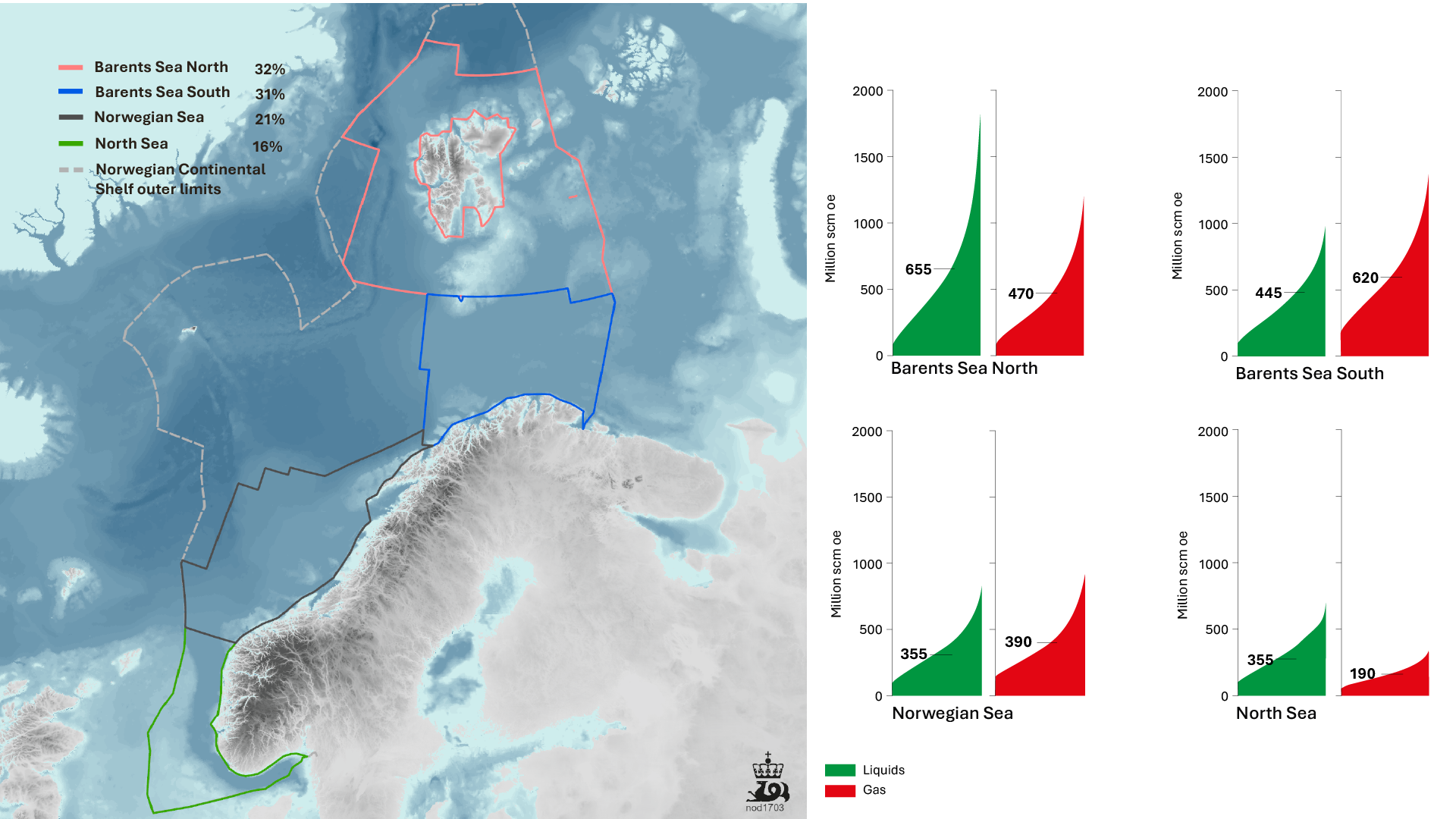
Figure 3-1 This figure shows the distribution of undiscovered liquids and gas in the various ocean areas with the range of uncertainty. The percentages on the map reflect expected values.
The percentages in the map in Figure 3-1 show the distribution between total undiscovered resources in both open and unopened areas in each ocean area.
About 63 per cent of the undiscovered resources are located in the Barents Sea. The Barents Sea North is the ocean area with the highest estimate for undiscovered liquids resources, while the Barents Sea South has the equivalent for gas resources. These are the ocean areas with the greatest uncertainty, which is reflected in the considerable range between the high and low estimates.
There are also considerable undiscovered resources in the North Sea and the Norwegian Sea. Due to existing infrastructure, there is a considerable potential for value creation in these ocean areas, even in discoveries of minor deposits. In the North Sea, we expect liquids to account for the largest share, while there is an equal distribution between undiscovered liquids and gas in the Norwegian Sea. The range of uncertainty illustrated in Figure 3-1 is from P95 to P05 in the estimated probability distribution for the resource outcome, which means that it is 95 per cent likely that the volume of undiscovered resources is higher than this P95, and 5 per cent likely that the volume is greater than this P05. The figures are listed in Table 3-1.

Table 3-1 This table shows undiscovered resources by ocean area with a range of uncertainty.
Undiscovered resources in opened and unopened areas
The Norwegian Offshore Directorate expects undiscovered resources to make up 22 per cent of the overall resources on the NCS. Sixty per cent of this is in opened areas. These are distributed across 29 per cent in the Barents Sea, 15 per cent in the Norwegian Sea and 16 per cent in the North Sea, as shown in Figure 3-2.
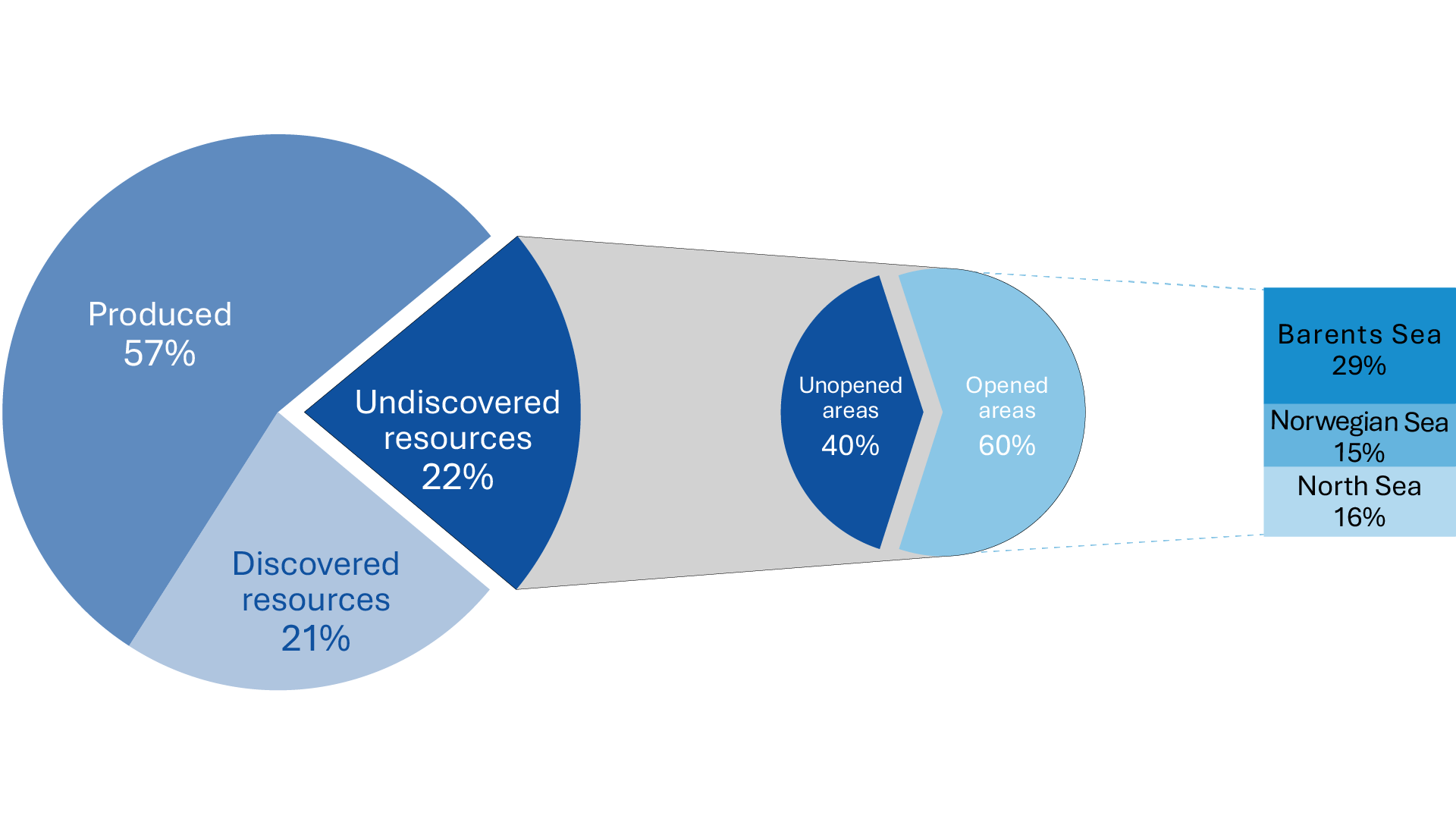
Figure 3-2 This figure shows undiscovered resources distributed by opened and unopened areas.
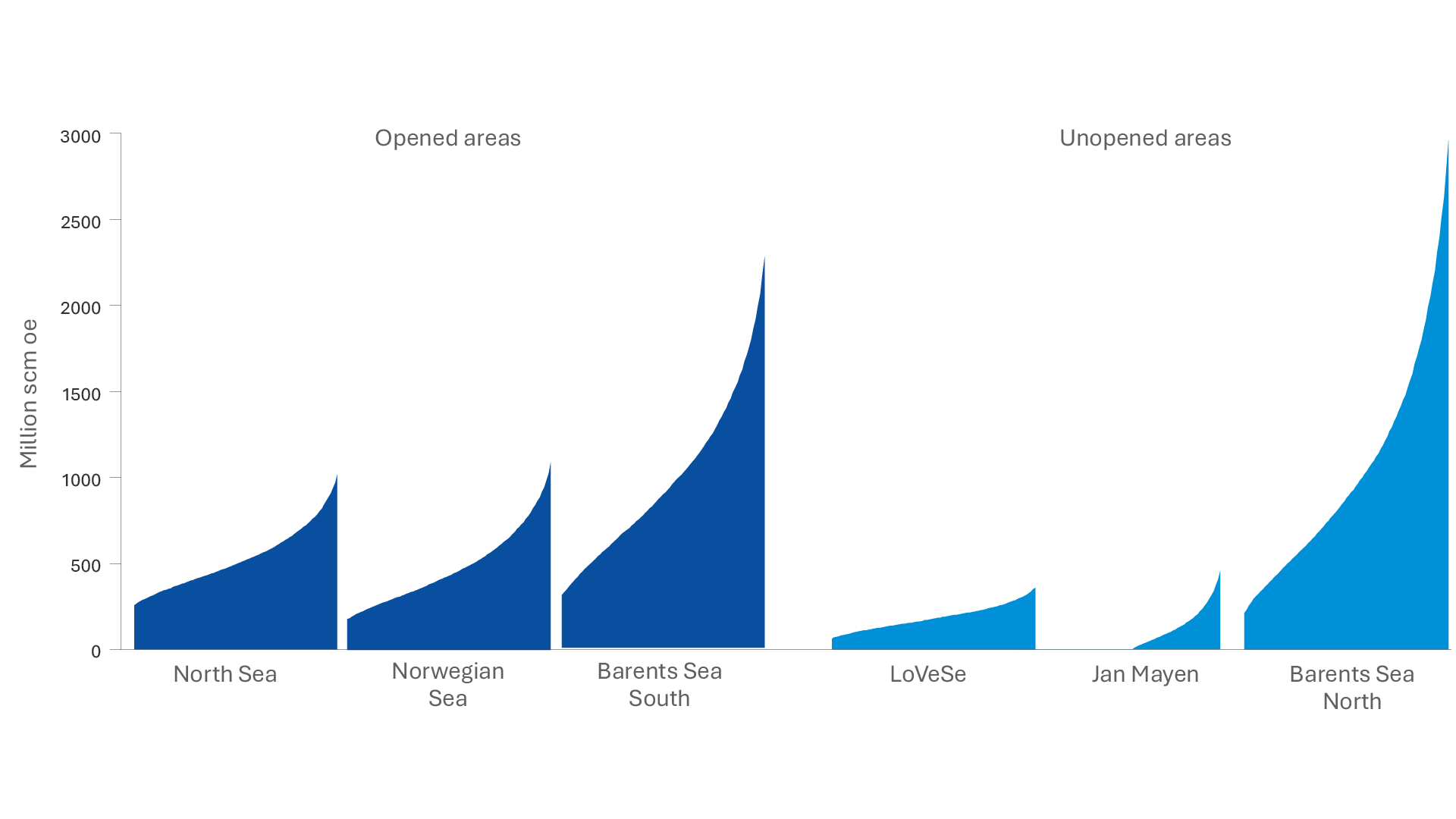
Figure 3-3 This figure shows undiscovered resources in opened and unopened areas with a range of uncertainty. LoVeSe is an abbreviation for the ocean areas off Lofoten, Vesterålen and Senja.
Despite the somewhat greater overall resource potential in the opened areas, the upside is greatest in the unopened part of the Barents Sea (Barents Sea North). This is also the area with the greatest uncertainty, as shown in Figure 3-3. The resources in LoVeSe are distributed between the Norwegian Sea and the Barents Sea South.
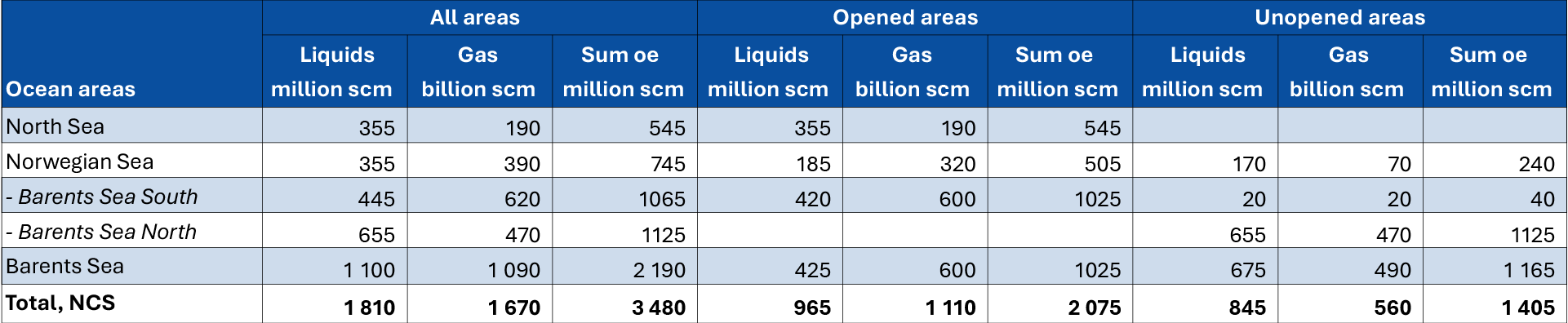
Table 3-2 This table shows undiscovered resources by ocean area, in opened and unopened areas.
Undiscovered resources in Norwegian ocean areas
North Sea
The estimate for undiscovered resources in the North Sea is 545 million Sm3 of recoverable o.e., distributed between 355 million Sm3 of liquids and 190 billion Sm3 of gas. This amounts to a reduction of 20 million Sm3 of recoverable o.e. from the previous year. This decline was caused by substantial exploration activity in the North Sea in 2025, with a total of 24 completed wildcat wells, eleven of which made discoveries.
Even in a mature area such as the North Sea, there is still significant uncertainty in the estimates for undiscovered resources, as illustrated in Figure 3-1. This figure shows a probability distribution where the low end is the P95 estimate and the high end is the P05 estimate. These figures indicate the expected value in the distribution. This is normally somewhat higher than the P50 value.
Uncertainty in resource estimates
The uncertainty is an expression of the range of potential resource outcomes or results. It can be described in many different ways, but most frequently using a low and a high estimate.
When it comes to undiscovered resources, the Norwegian Offshore Directorate uses P95 for the low estimate. Based on the underlying assumption for the analysis, there is a 95 per cent likelihood that the result is equal to or greater than the P95 value. P05 is used for the high estimate, which means that there is a five per cent likelihood that the result will be equal to or greater than the P05 value.
The expected value is the average value. This is often defined as the arithmetic mean of all outcomes in the statistical distribution. This is used very frequently and its defining property is that the expected value of different distributions is equal to the sum of the expectation for each distribution. The expected value is normally somewhat higher than the P50 value.
Major discoveries cannot be ruled out in the North Sea, but most discoveries are expected to be relatively minor. The average discovery size in the North Sea over the last five years is about 3.5 million Sm3 of recoverable o.e.
Norwegian Sea
The estimated undiscovered resources in the Norwegian Sea amount to 745 million Sm3 of recoverable o.e., distributed between 355 million Sm3 of liquids and 390 billion Sm3 of gas. This is a reduction of 15 million Sm3 of recoverable o.e., the majority of which is associated with exploration activity in 2025.
The resource estimates for the Norwegian Sea also include the resource volumes in the unopened areas off Lofoten, Vesterålen and Senja, as well as in the ocean area around Jan Mayen. These areas account for about 32 per cent of the total estimate. See Table 3-2 for the distribution between opened and unopened areas.
Barents Sea
The estimated undiscovered resources in the Barents Sea amount to 2,190 million Sm3 of recoverable o.e., distributed between 1,100 million Sm3 of liquids and 1,090 billion Sm3 of gas.
The estimated undiscovered resources in the Barents Sea South amount to 1,065 million Sm3 of recoverable o.e., distributed between 445 million Sm3 of liquids and 620 billion Sm3 of gas. The overall increase of 25 million Sm³ of recoverable o.e. was mainly caused by the update of a play in the Triassic-Permian, as a result of discoveries on 7122/9-2 (Elgol) and 7122/9-1 (Lupa).
The Barents Sea South has seen a relatively low level of exploration activity over the last five years. Only 20 wildcat wells have been completed; five of which were drilled in 2025. A total of 15 discoveries were made in these 20 wells. In comparison, 31 wildcat wells were completed during the previous five-year period.
The Barents Sea holds about 54 per cent of the resources in areas not yet opened for petroleum activities, and 97 per cent of these resources are located in the Barents Sea North. This is the area with the highest likelihood of making new, major discoveries on the NCS, but it is also the area with the greatest uncertainty.
The estimated undiscovered resources in the Barents Sea North amount to 1,125 million Sm3 of recoverable o.e., distributed between 655 million Sm3 of liquids and 470 billion Sm3 of gas. This estimate has remained unchanged from the previous resource accounts, as this area was not subject to geological evaluation in 2025.
Updated: 2/27/2026