
Production, operating Fields and investments
CONTINUED HIGH ACTIVITY ON THE SHELF
Production and investments remained at a high level in 2025. New and improved technology means that fields can produce for longer than originally planned, but new investments will be needed to maintain production moving forward.
Read about:
- Oil production up, gas down slightly
- High level of investment, but a decline is expected
- Awards in pre-defined areas (APA)
- Projects and developments
- Production start-up and continuation
- Emissions and power from shore
Oil production up, gas down slightly
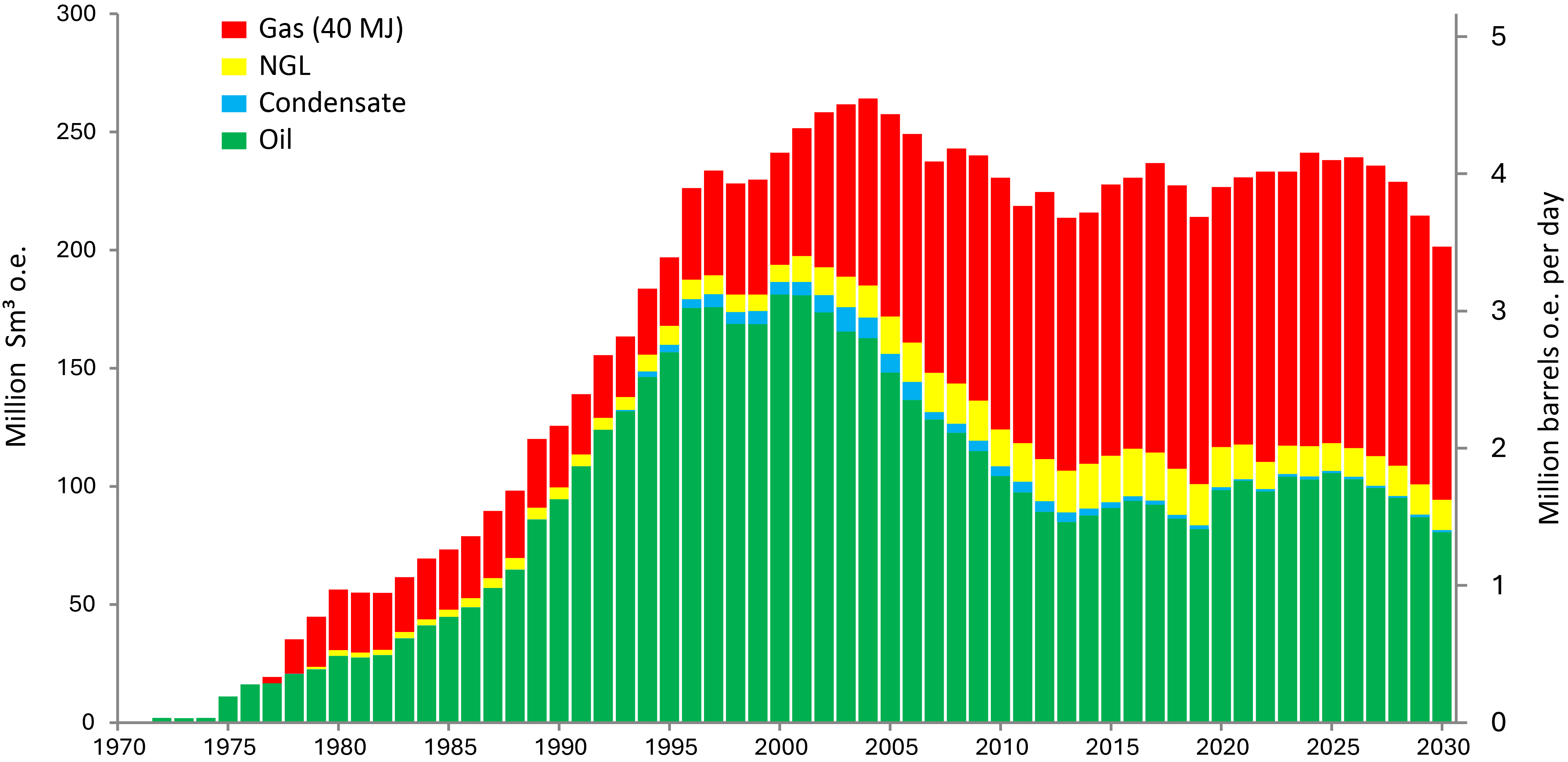
Oil production in 2025 amounted to about 106 million standard cubic metres (Sm3), which represents the highest level of production since 2009.
The Johan Sverdrup field in the North Sea accounts for close to 40 per cent of this, and the field has produced at plateau over the last three years. The field will continue to provide a significant share of oil production over the next few years, despite gradually declining from plateau.
The Johan Castberg field in the Barents Sea started producing in March and has gradually contributed to increased oil production on the shelf. The field reached plateau production in the summer of 2025, and the Directorate expects plateau production to be maintained for several years before a natural decline.
Production from the NCS is nearly equally distributed between oil and gas. A total of about 120 billion standard cubic metres of gas (Sm3) was sold. This is a minor reduction compared with the record-breaking year of 2024. We expect gas production to remain at this level over the next three to four years.
Norwegian gas accounts for about 30 per cent of EU gas consumption, and Norway is Europe's largest supplier after cutting off Russian gas.
The Troll field in the North Sea accounts for about one-third of overall gas production, and this situation will continue over the next few years.
Total production on the NCS (oil, gas, NGL and condensate) amounted to 238 million standard cubic metres of oil equivalent (MSm3 o.e.). Production is expected to remain at a stable, high level over the next few years, and will then gradually decline towards the end of the 2020s.
At year-end 2025, there were 97 fields in operation on the Norwegian shelf. The Halten Øst and Verdande fields in the Norwegian Sea, as well as Johan Castberg in the Barents Sea, came on stream, and no fields were shut down over the past year. The Norwegian Offshore Directorate expects a number of new fields to come on stream over the years to come.
One important reason why production remains at such high levels is that the fields are producing for longer than originally planned. New and improved technology has allowed us to continuously improve our understanding of the subsurface. This has enabled the industry to further develop the fields. New development projects, more production wells and exploration in the surrounding area have helped extend the lifetimes of most fields.
Certain fields that are no longer producing are also being considered for reopening. They are planned with a simpler development solution tied back to existing and surrounding infrastructure. One example is the shuttered fields of Albuskjell, Vest Ekofisk and Tommeliten Gamma in the Greater Ekofisk Area. The plan for these fields is to develop them with a subsea solution tied back to the Ekofisk Complex.
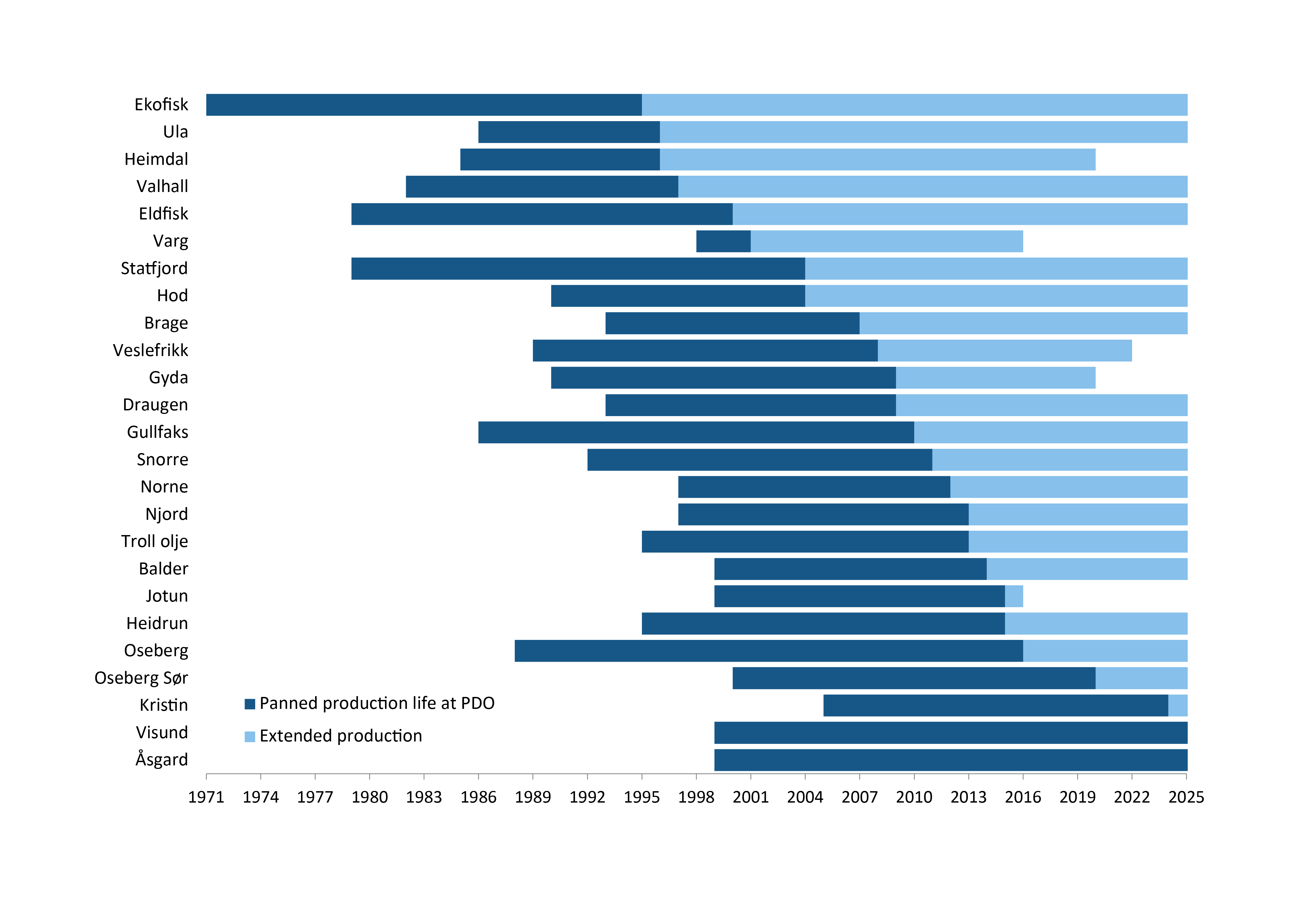
The figure below shows a number of fields that are producing between 10 and 30 years longer than originally planned. Several of these fields will continue to produce after 2030, and some even to 2040. This will provide a significant contribution to production and value creation on the shelf.
The Norwegian Offshore Directorate publishes preliminary production figures on a monthly basis.
High level of investment, but a decline is expected
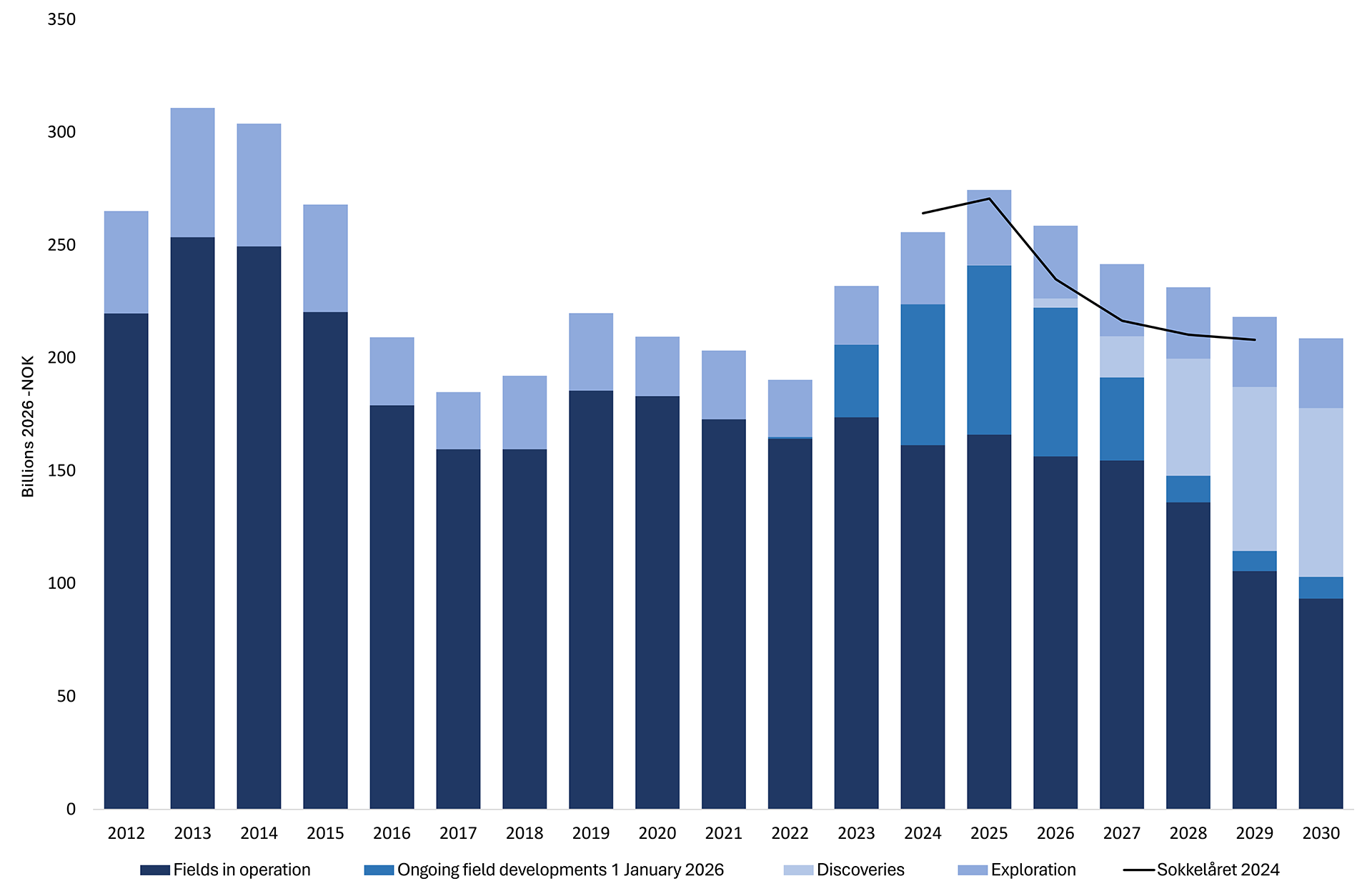
In 2026, the Norwegian Offshore Directorate expects investments on the NCS totalling NOK 256 billion. This represents a reduction of 6.5 per cent from the previous year. The Directorate expects the investment level to decline gradually leading up to 2030.
Significant activity and scarce capacity in parts of the supplier industry, presumed extended lifetimes for several production facilities and growth in costs have led to higher projected costs and investments. This is especially for 2026–2029, compared with what was presented in early 2025. Additional development wells and higher drilling costs per development well also contribute to a higher level of investment. Projected investments for certain ongoing developments have also increased (Prop. 1 S, 2025–2026) (Norwegian only).
The primary cause of falling investments moving forward is the gradual completion and production start-up of ongoing development projects. This will take place without new projects of an equivalent scope expected to come on stream.
A few previously planned projects aimed at reducing greenhouse gas emissions by transitioning to operations with power from shore have been suspended due to challenging profitability. These were investment-heavy projects that, according to earlier forecasts, accounted for a substantial share of the level of investment and activity leading up to 2030.
Despite the high level of activity in the industry in 2025, new investments will be necessary to maintain future production.
We expect exploration activity and exploration costs in 2026 to be somewhat lower than in 2025.
Awards in pre-defined areas (APA)
In January 2025, 20 companies were offered ownership interests in a total of 53 production licences in the awards in APA 2024.
When the application deadline for APA 2025 expired on 2 September, the authorities had received applications from 20 companies. This is on par with APA 2024 and shows that the Norwegian continental shelf remains attractive for exploration and long-term production. New production licences in the announced areas are expected to be awarded in early 2026.
The Norwegian Offshore Directorate has invited the companies to nominate blocks for the 26th licensing round on the NCS.
Projects and developments
Comprehensive area solutions are becoming increasingly important in connection with ongoing and future developments on the NCS. Crucial drivers include multiple minor discoveries, higher development costs, technical assessments of installation lifetimes and future emission profiles.
The plan for development and operation (PDO) for Fram Sør, which is located in the northern part of the North Sea, was approved in 2025. Investments in the project are estimated at about 21 billion 2025-NOK.
Several new development plans are expected over the upcoming years. Most of these are relatively small discoveries that are being developed with subsea templates or wells from existing subsea templates, and tied back to existing infrastructure.
At the end of the year (Proposition 1 S to the Storting (2025-2026) (Norwegian only), 17 development projects or field developments with approved development plans were under way on the NCS. Eight of the projects are in the North Sea, eight in the Norwegian Sea and one in the Barents Sea. These projects will help keep the investment level high and slow the underlying decline in production over the next decade. Additional development projects will also help extend lifetimes and thereby lead to improved recovery from existing fields.
The largest discoveries that have yet to be developed are 7324/8-1 (Wisting) in the Barents Sea, 6406/9-1 (Linnorm) in the Norwegian Sea and 35/2-1 (Peon) in the North Sea (see the chapter "Resources and challenges in discoveries" in Resource Report 2024). These discoveries are all being considered for development and could contribute considerable resources and values over the next few decades.
Production start-up and continuation
The consent system is how the authorities follow up to ensure that licensees conduct their activities in line with the regulations and previous decisions. The consent entails a verification that preconditions in the plan for development and operation (PDO), plan for installation and operation (PIO) and disposal decisions are fulfilled.
The table below shows consents for start up and continuation issued in 2025.
| Field/project | Consent to | Commencement/planned commencement |
| Askeladd Vest | Commencement of installations | 19 September 2025 |
| Ormen Lange phase 3 | Commencement and use of facilities | 26 August 2025 |
| Halten Øst | Commencement of installations | 17 March 2025 |
| Maria phase 2 | Commencements of new installations | 23 May 2025 |
| Smørbukk Midt | Commencement | 18 September 2025 |
| Troll B | Commencement and continuation of gas export solution | 12 October 2025 |
| Andvare | Commencement | 29 September 2025 |
| Verdande | Commencement | 25 November 2025 |
| Åsgard B low-pressure phase 3 | Commencement and continuation | Jan. 2026 |
| Kristin (installation) | Continuation | 23 October 2025 |
Emissions and power from shore
Despite relatively stable production, greenhouse gas emissions on the NCS have been declining since 2015. Converting to power from shore on the fields has been the most important measure.
Since 2015, these emissions have been reduced by 4.1 million tonnes, or 27 per cent. This is according to the report "Power from shore 2025", which the Norwegian Offshore Directorate prepared on assignment from the Ministry of Energy in 2025.
The primary source of emissions from the NCS is the combustion of gas in gas turbines. There are also emissions from the combustion of gas and diesel in boilers and motors, in safety flaring of ngas, diesel in turbines, engines and boilers, venting and fugitive gas emissions, as well as in connection with storage and loading of crude oil.
Emissions are expected to increase somewhat over the short term, followed by a new decline once ongoing projects to convert to power from shore are operational. Conversions to power from shore are under way on Melkøya, the Troll and Oseberg fields in the North Sea, as well as Njord and Draugen in the Norwegian Sea.
Recent years have brought several plans to convert to operations using power from shore. Many of these plans have been suspended due to the challenges faced to achieve profitability. Work is still under way to study power from shore to the Balder and Grane fields in the North Sea.
The distribution of emission sources from the petroleum sector
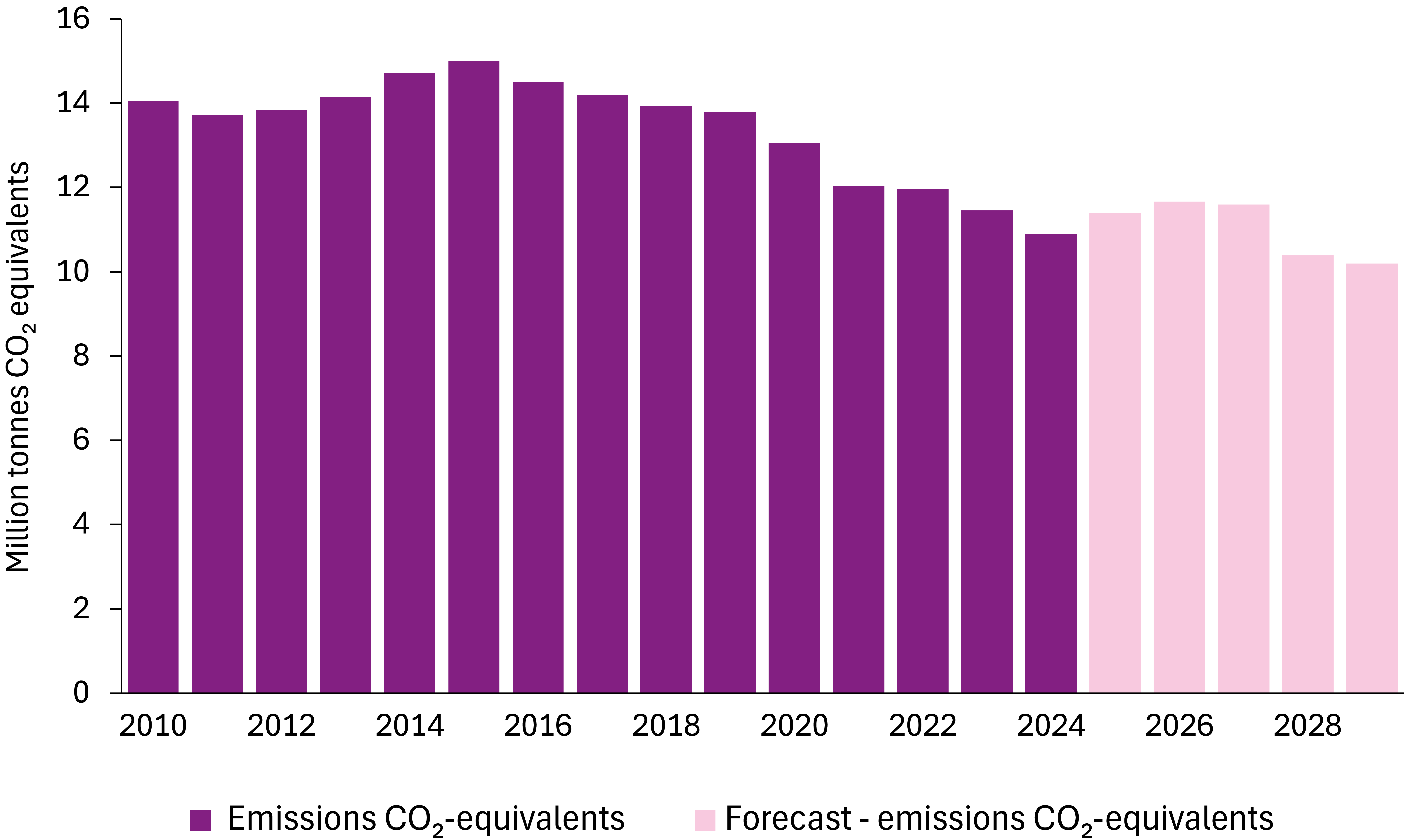
This figure is based on data from the National Budget for 2026. Power from shore projects that have been planned and which are now suspended, were not scheduled to be in operation until after 2033.
Download: Background data (Excel)
Updated: 1/8/2026