New industries on the shelf
STORAGE OF CO2 UP AND RUNNING
Carbon capture and storage (CCS) is up and running, and commercial storage from major industrial players is now possible on the NCS. We have continued the acquisition of data on seabed minerals and the environment.
Read about:
- CO2 storage up and running as an industry on the NCS
- Mapped seabed minerals and deep-sea environments
CO2 storage up and running as an industry on the NCS
2025 saw Northern Lights complete its first successful CO2 injection. This means that the world’s first full-scale value chain for carbon capture and storage is now well under way on the NCS. More than 39,000 tons of CO₂ were injected last year.
The Northern Lights plant in Øygarden is the only plant in the world that can receive CO2 across national borders. The Norwegian authorities have approved development plans for commercial storage of at least 5 million tonnes of CO2 per year. Agreements have been entered into with industrial players both in Norway and abroad.
Three licences were awarded in 2025 pursuant to the Regulations relating to exploitation of subsea reservoirs on the continental shelf for storage of CO₂ and relating to transportation of CO₂ on the continental shelf. Two of these licences were offered in 2024, and awarded in February 2025. There was one licensing round in 2025, with announcement in March and awards in June. One licence has been relinquished to the authorities.
A total of 13 licences have been awarded; one exploitation licence and 12 exploration licences. The potential storage volume in these projects exceeds two billion tonnes, while the potential in these areas is more than 10 billion tonnes. How much of this that actually can be stored will depend on several factors, including information from further mapping, access to CO2 in the market and which development solution the project ultimately chooses.
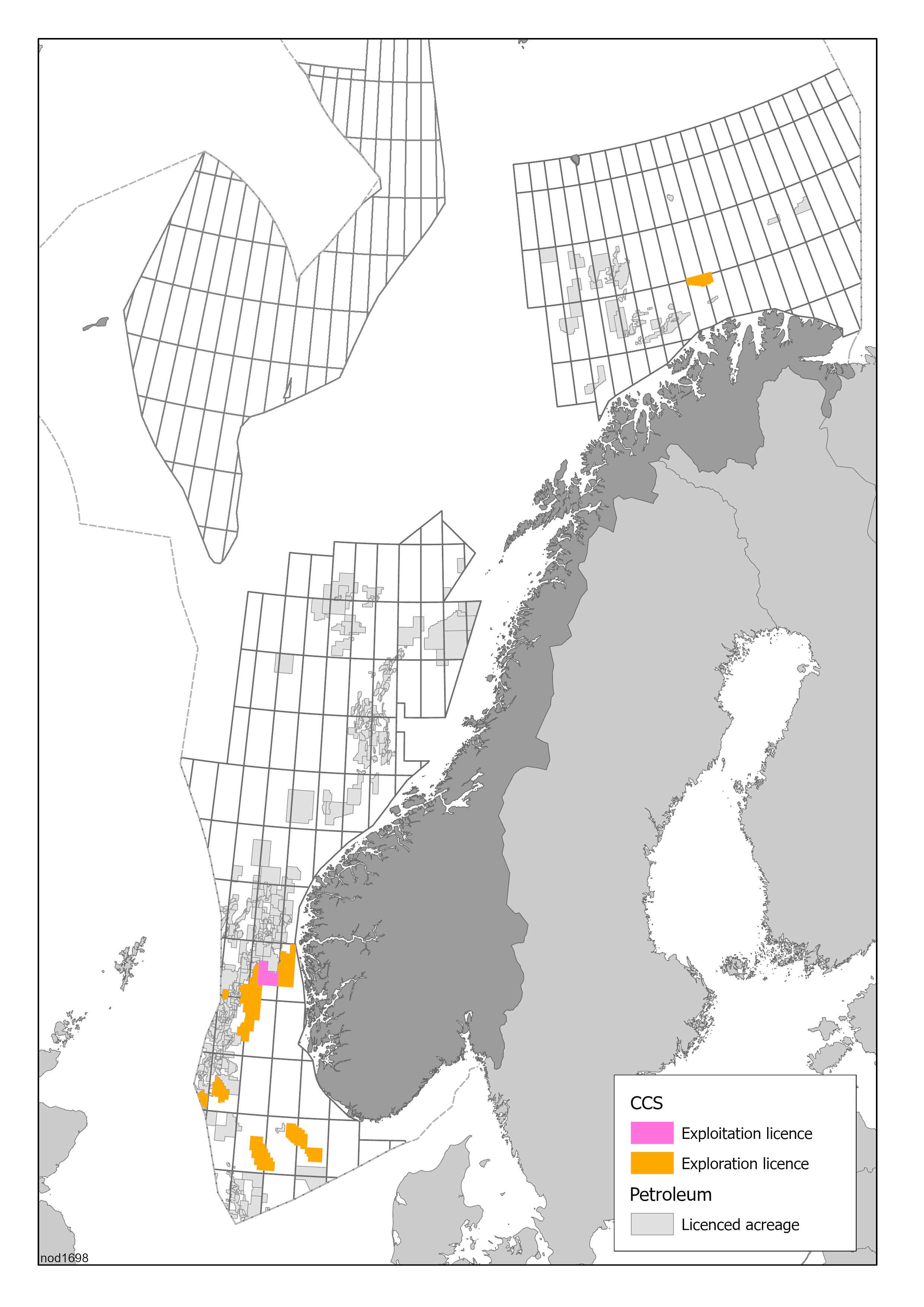
The NCS has a theoretical storage capacity of more than 80 billion tonnes of CO2, the equivalent of about 1800 years of Norway's total CO2 emissions at current levels.
Learn more about CO2 storage and the different types of licences in Resource Report 2024.
Coexistence between CCS and petroleum
Several of the awarded exploration licences for CCS (carbon capture and storage) are located near producing petroleum fields. CO2 injection and petroleum production both affect the pressure in the aquifer. This means that they can impact each other's activity. The Norwegian Offshore Directorate is working on a project to address issues between CO2 storage and petroleum activities. This work is using a large reservoir model that can provide an indication of how the two industries' activities can have an impact on each other.
Mapped seabed minerals and deep-sea environments
In 2025, the Norwegian Offshore Directorate coordinated three research expeditions in the Norwegian Sea and the Greenland Sea and collected large volumes of water depth data (bathymetry), video data and sediment cores.
The objective is to map deposits of seabed minerals and acquire various deep-sea environmental data. One expedition acquired samples for the Mareano programme, where the Norwegian Offshore Directorate is part of both the Programme Group and Executive Group.
Read more about the expeditions here.
Data from expeditions in 2025 has been made available.
The Norwegian Offshore Directorate cooperates closely with the academic community in its deep-sea mapping efforts.
In 2026, the Norwegian Offshore Directorate is planning to conduct a new resource assessment for seabed minerals based on data obtained in recent years.
The Directorate has procured an autonomous deep-sea AUV along with the University of Bergen (UiB). It will be operated by UiB and can be used to map the deep sea.
The Norwegian Offshore Directorate has also purchased a multibeam echo sounder, which is owned by the University of Tromsø (UiT) and installed on the R/V Helmer Hanssen research vessel. This echo sounder provides better image resolution for bathymetric mapping.
In March, the Centre for Deep Sea Research at UiB and the Norwegian Offshore Directorate found a new sulphide deposit on the NCS.
Download: Background data (Excel)
Updated: 1/8/2026