The player landscape
Many of the international companies which were present on the NCS in the 2000s have pulled out, and the shelf is currently dominated by a few Norwegian-based companies. This has many positive aspects in the development and production phase, but can weaken the diversity of ideas and competition needed to develop the remaining resource potential. The challenge going forward is not the number of companies per se, but ensuring sufficient diversity in geological assessments, risk approaches and technology choices.
In this chapter:
The companies are grouped by strategy and business area, including size (in terms of market value), geographical origin, placement in the value chain and interests in production licences. See a more detailed description of the company categories in the table below.
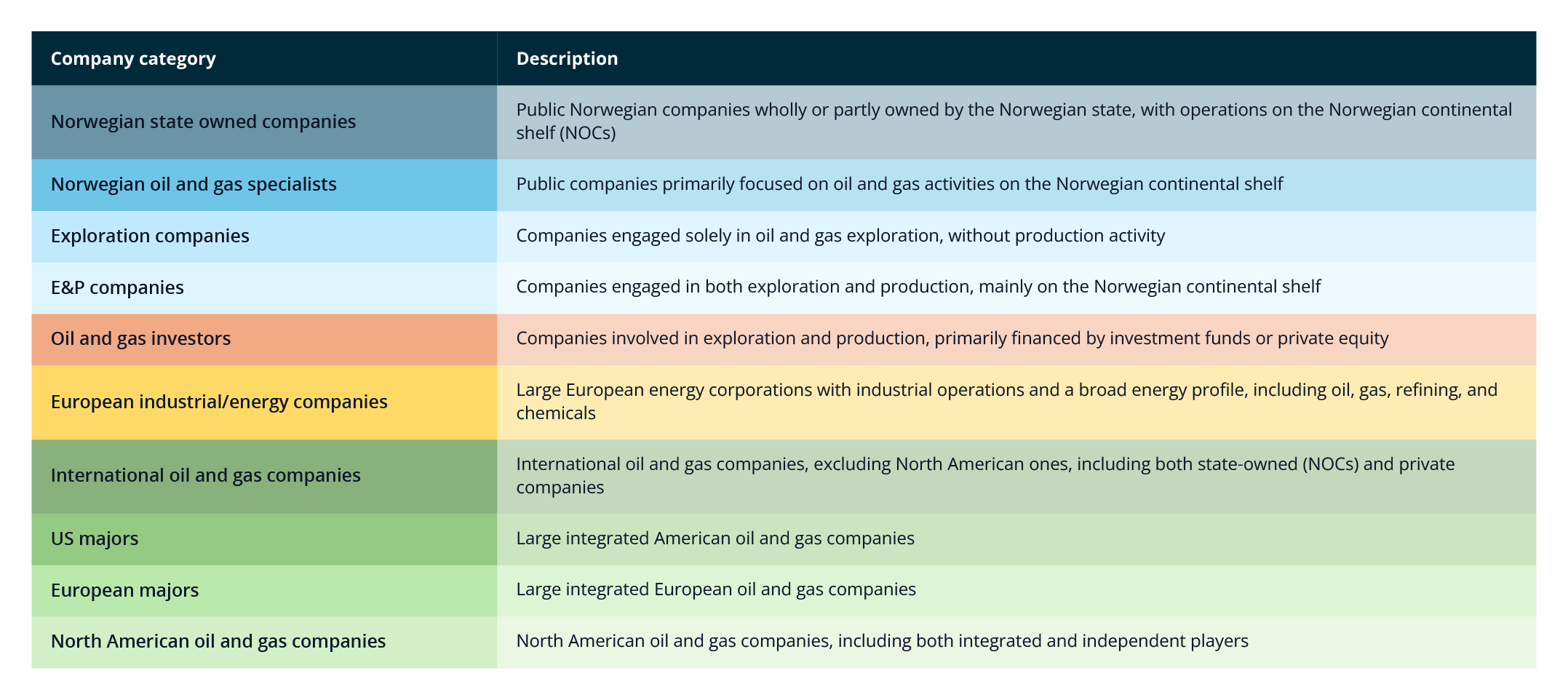
Table 5.1 Company categories
Figure 5.1 shows all companies that were active as of 31.12.2025.
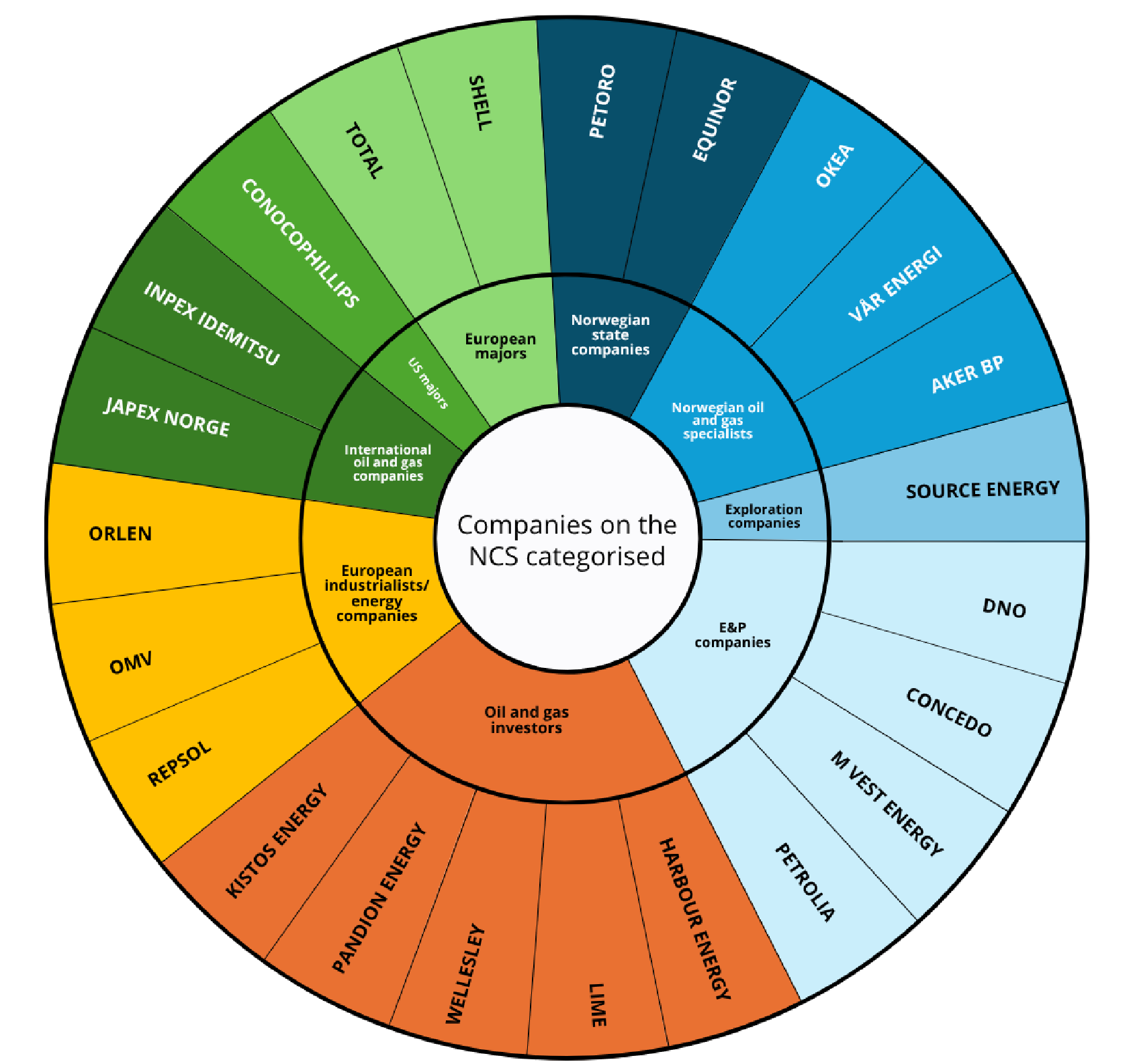
Figure 5.1 Company types and companies on the Norwegian continental shelf (31.12.2025)
The composition of companies on the Norwegian continental shelf (the player landscape) has changed significantly over the past 25 years. Following a period of increase towards 2013, the number of active players in 2025 has more than halved from the 2013 level (see Figure 5.2).
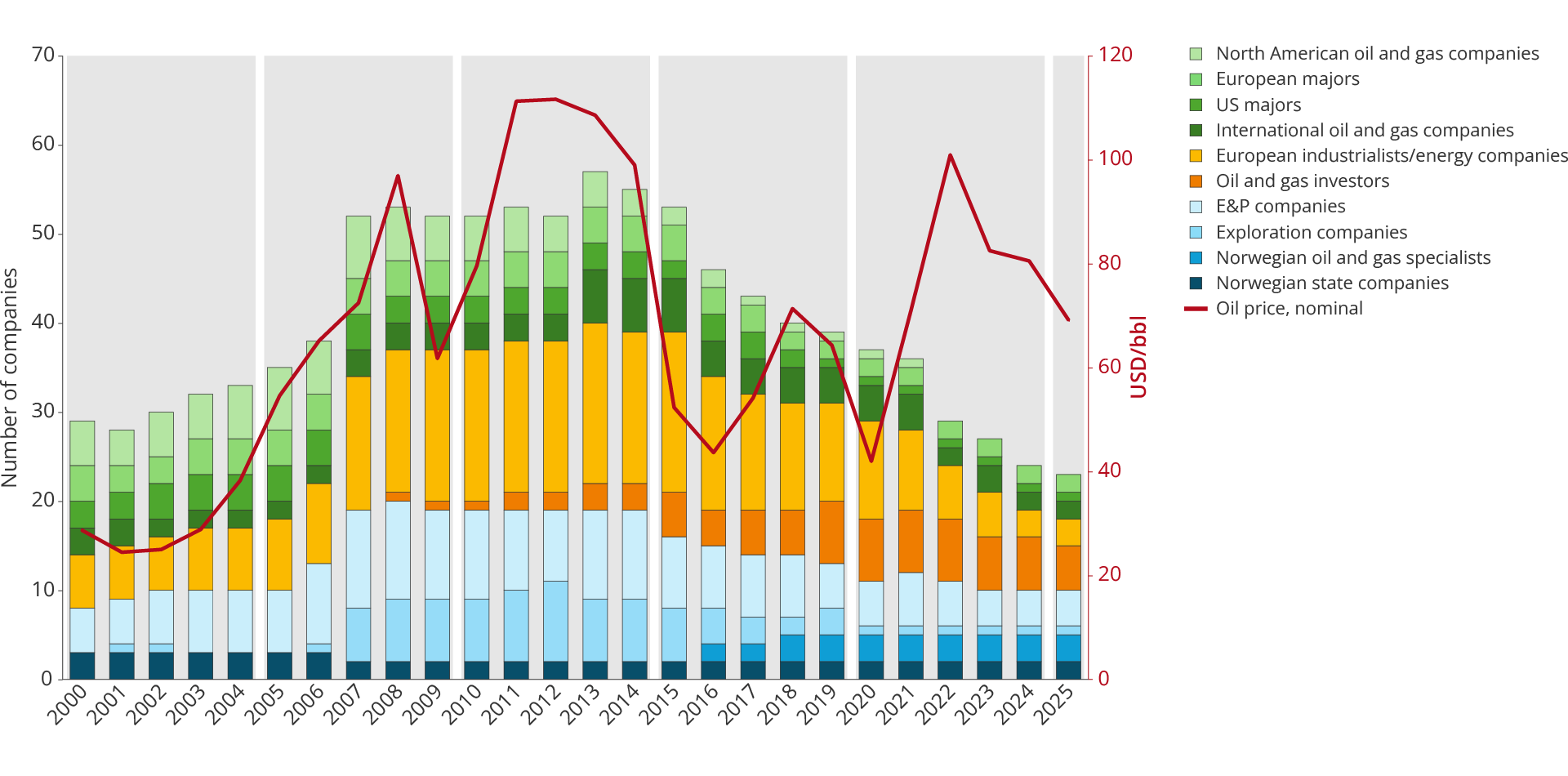
Figure 5.2 Development in the number of companies on the NCS by company category 2000–2025
Fewer players can weaken diversity in the exploration phase. Diversity provides more independent geological assessments which can increase the likelihood of large discoveries, especially in underexplored areas. In the development and operation phase, more players can strengthen competition, which contributes to increased efficiency and innovation through different technological approaches and business models. However, more players can make coordination and commercial negotiations more challenging.
Developments in the player landscape 2000–2025
2000–2004: The legacy of the 1990s
This period marked the end of an established development on the NCS. The player landscape from the late 1990s was largely continued, particularly in the exploration phase.
Few and large players dominated the shelf, with Statoil and Norsk Hydro playing key roles. These were supplemented by major international oil companies, such as Shell, Total, ExxonMobil and ConocoPhillips.
Statoil was listed on the stock exchange in 2001, and Petoro was established as the manager of the State's Direct Financial Interest (SDFI).
The exploration phase
The introduction of the scheme for Awards in Predefined Areas (APA) in 2003 was an important reform but did not result in immediate changes to the player landscape. Exploration activity was low, and in 2004 only eight exploration wells were spudded (see Figure 5.3)
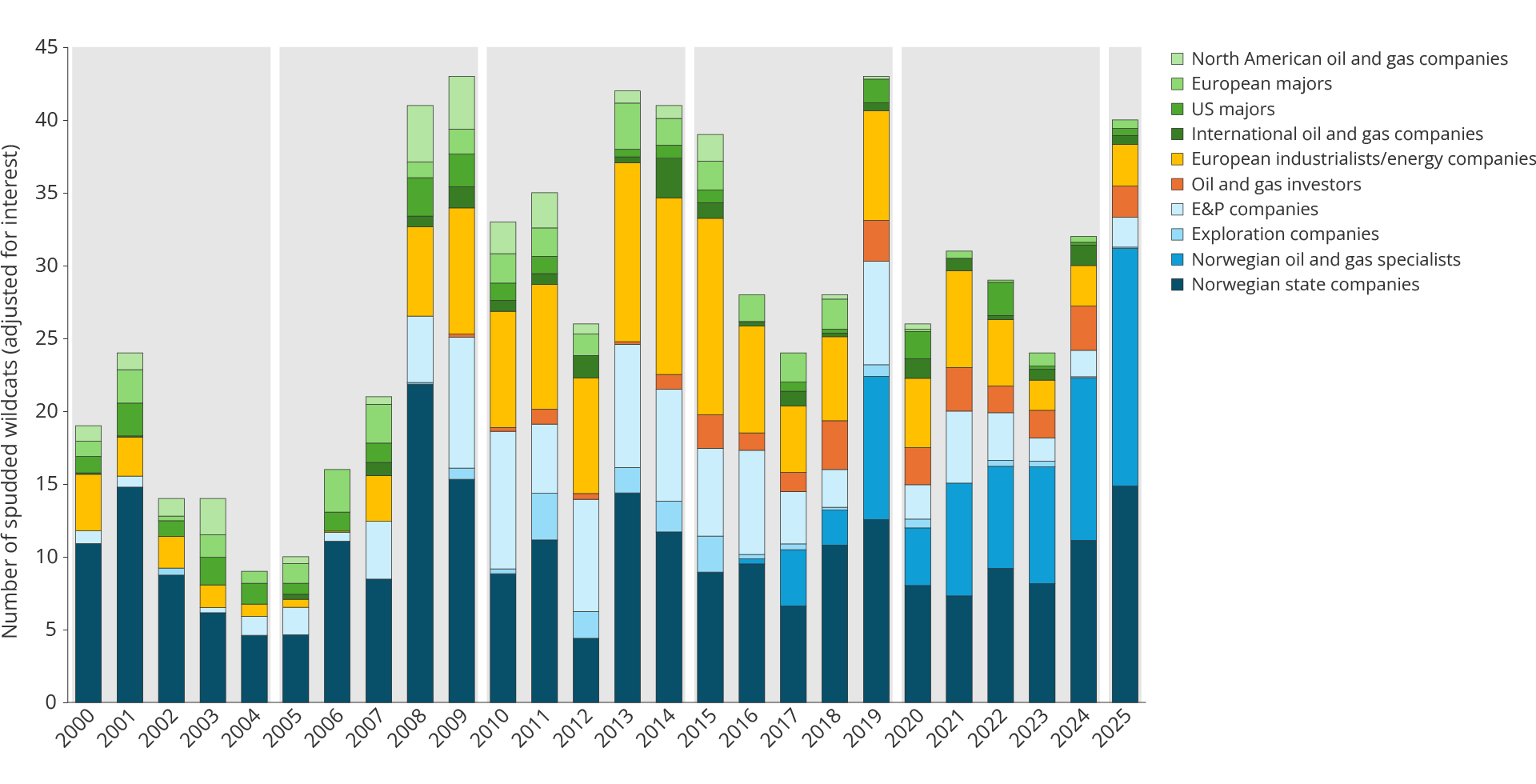
Figure 5.3 Spudded wildcats by company category (licensees)
Development and operation phase
In the development and operation phase, Statoil and Norsk Hydro were the dominant companies during the period and accounted for the largest share of production (see Figure 5.4).
The player landscape was characterised by continuity and few changes in operatorship. The licensees on fields such as Kristin and Ormen Lange continued the concentrated ownership structure from the 1990s.
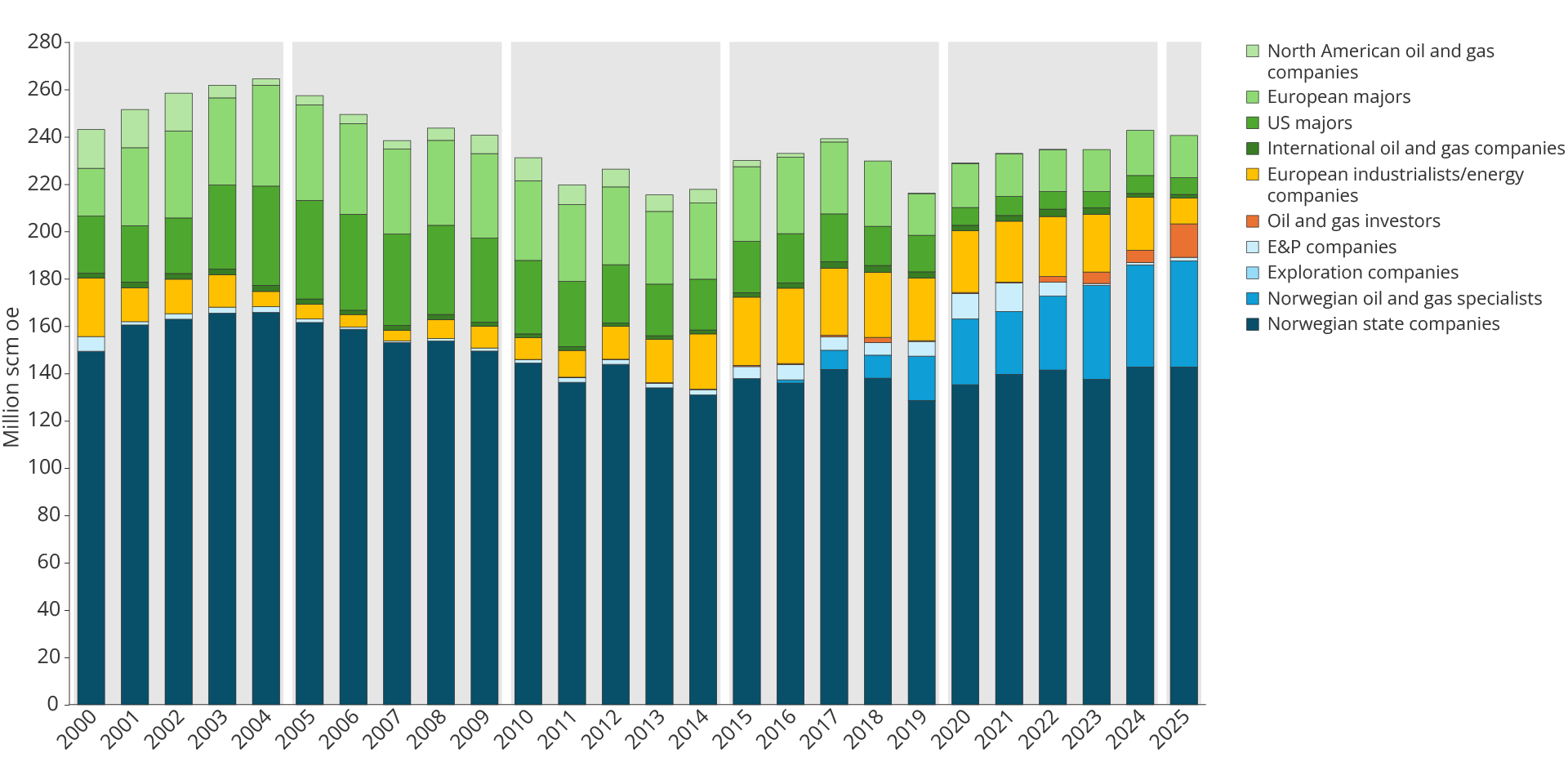
Figure 5.4 Development in production by company category (licensees)
2005–2009: Oil price upturn, exploration reimbursement and new players
The exploration phase
The introduction of the exploration reimbursement scheme in 2005 led to several smaller companies entering the shelf. From this point on, exploration companies that were not in a tax-paying position were entitled to have 78 per cent of their exploration costs reimbursed directly by the government. The risk associated with drilling a dry well was significantly reduced and paved the way for companies with limited equity to finance their exploration activity.
The combination of the exploration reimbursement scheme and an oil price climbing steadily towards USD 100 per barrel made the NCS attractive to new players. The result was a wave of new exploration companies.
Companies such as Det norske oljeselskap, Revus Energy, Rocksource and PA Resources established themselves as active applicants primarily in the APA rounds.
Lundin was one of several targeted and long-term medium-sized exploration players. The company built up a broad portfolio of activities from the North Sea to the Barents Sea.
Development and operation phase
The merger of Statoil and Norsk Hydro to form StatoilHydro in 2007 strengthened the state's role in the development and operation phase. In the same year, the Ormen Lange field came on stream with Shell as operator, and StatoilHydro completed the Snøhvit liquefied natural gas (LNG) plant. The Goliat field in the Barents Sea received PDO approval in 2009, with Eni as operator.
The projects demonstrate that both large Norwegian and international companies assumed operator responsibility for technologically challenging projects, also in Arctic regions.
The contrasts between the diverse player landscape in the exploration phase and a more concentrated player landscape in the operational phase became more apparent during this period.
2010–2014: Economic boom and Johan Sverdrup
The exploration phase
High oil prices combined with the exploration reimbursement scheme improved framework conditions for exploration activities. The number of companies participating in the APA rounds and in the numbered licensing rounds reached historically high levels.
In 2010, the 16/2-6 well that proved Johan Sverdrup was drilled by Lundin. This demonstrated that the NCS can still deliver world-class discoveries. It also signalled that such results are not reserved exclusively for the largest companies.
Towards the end of the period, from 2012–2014, the high level of exploration activity both globally and on the NCS contributed to a sharp increase in costs (see Figure 5.5). Rig rates, wages, and fees from service providers increased significantly. Profitability came under pressure despite high oil prices.
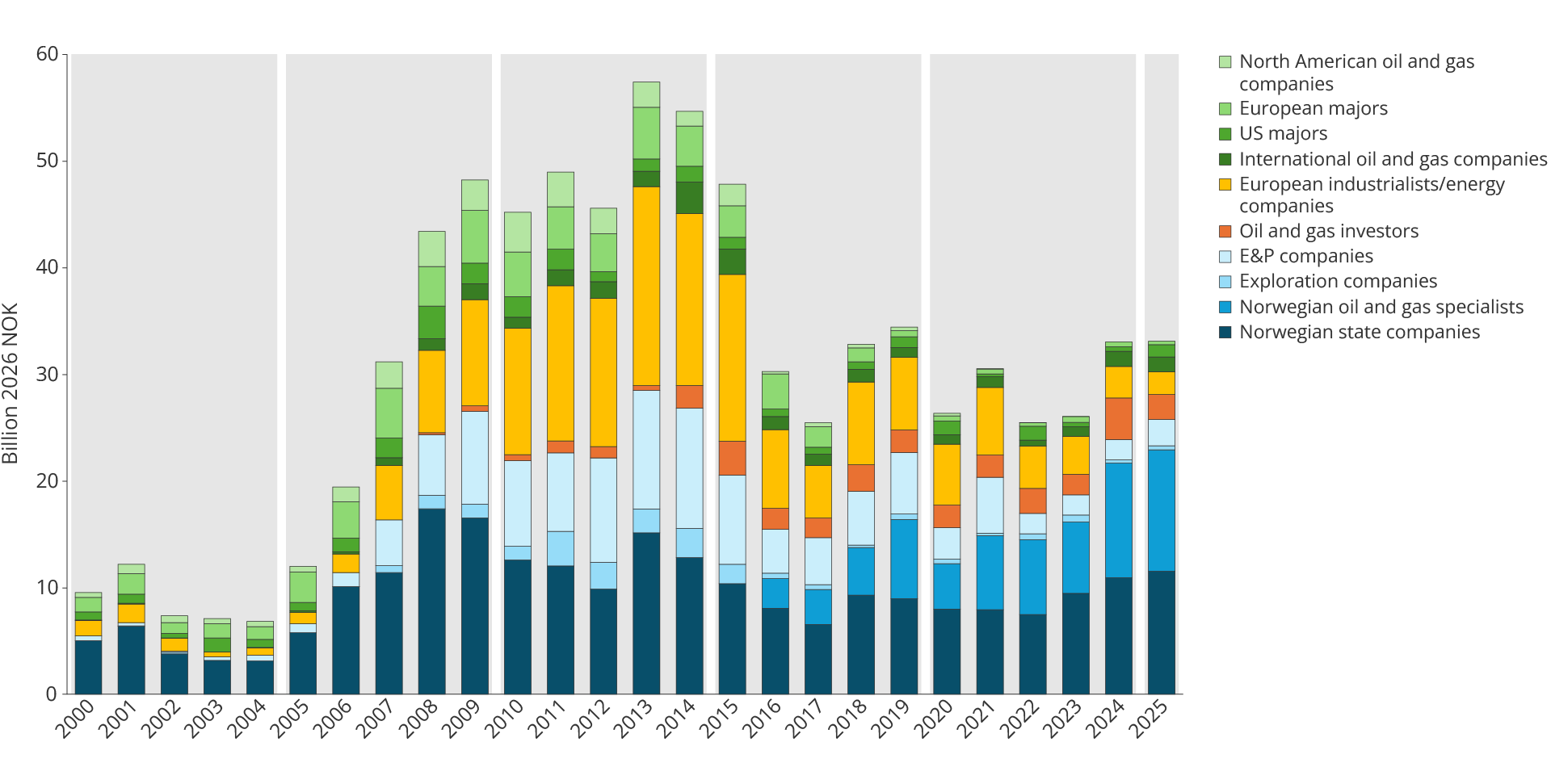
Figure 5.5 Exploration costs (exploration investments) by company categories (licensees) in the period 2000–2025
When the oil price drop hit in the summer of 2014, it targeted an industry already characterized by growing concern over cost levels.
Development and operation phase
The development and operation phase in the period 2010–2014 was characterised by a high level of activity (see Figure 5.6) and great ambitions, but also by increasing costs. Statoil retained its dominant position as operator and simultaneously had extensive international ambitions.
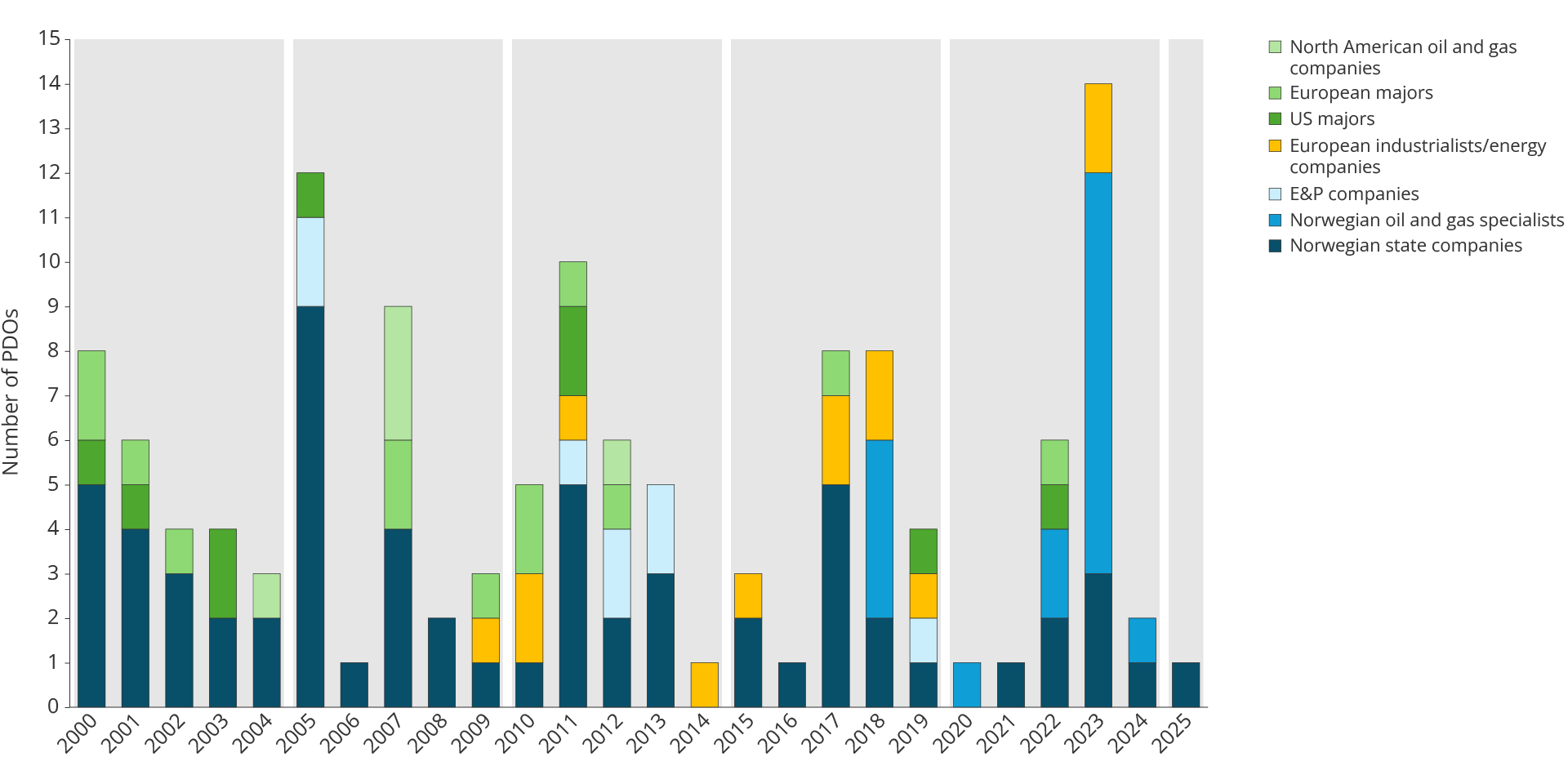
Figure 5.6 Approved PDOs per year by company category (operators)
2015–2019: Crisis and consolidation
The exploration phase
In the summer of 2014, oil prices began to drop. By January 2016, prices had been slashed from over USD 110 per barrel to below USD 30. This had drastic consequences for exploration activities. Exploration budgets were cut, rig contracts were terminated, and many smaller exploration companies found themselves financially challenged.
Several companies established between 2005 and 2014 had limited financial robustness and lacked the ability to handle a long-term drop in revenue, even with the exploration reimbursement scheme. The number of active exploration companies thus dropped markedly in the years following the oil price slump (see Figure 5.7).
Figure 5.7 Inflows and exits of companies on the Norwegian shelf (2000–2025)
During the boom from 2010 to 2014, the companies had ample access to capital for ambitious exploration strategies where high volumes were more important than a high probability of discovery. Following the oil price collapse, capital discipline became a key demand from both shareholders and lenders. As a result, the companies shifted their exploration portfolios towards smaller prospects close to existing fields and infrastructure, with a higher probability of discovery and shorter lead time to production (see Figure 5.8).
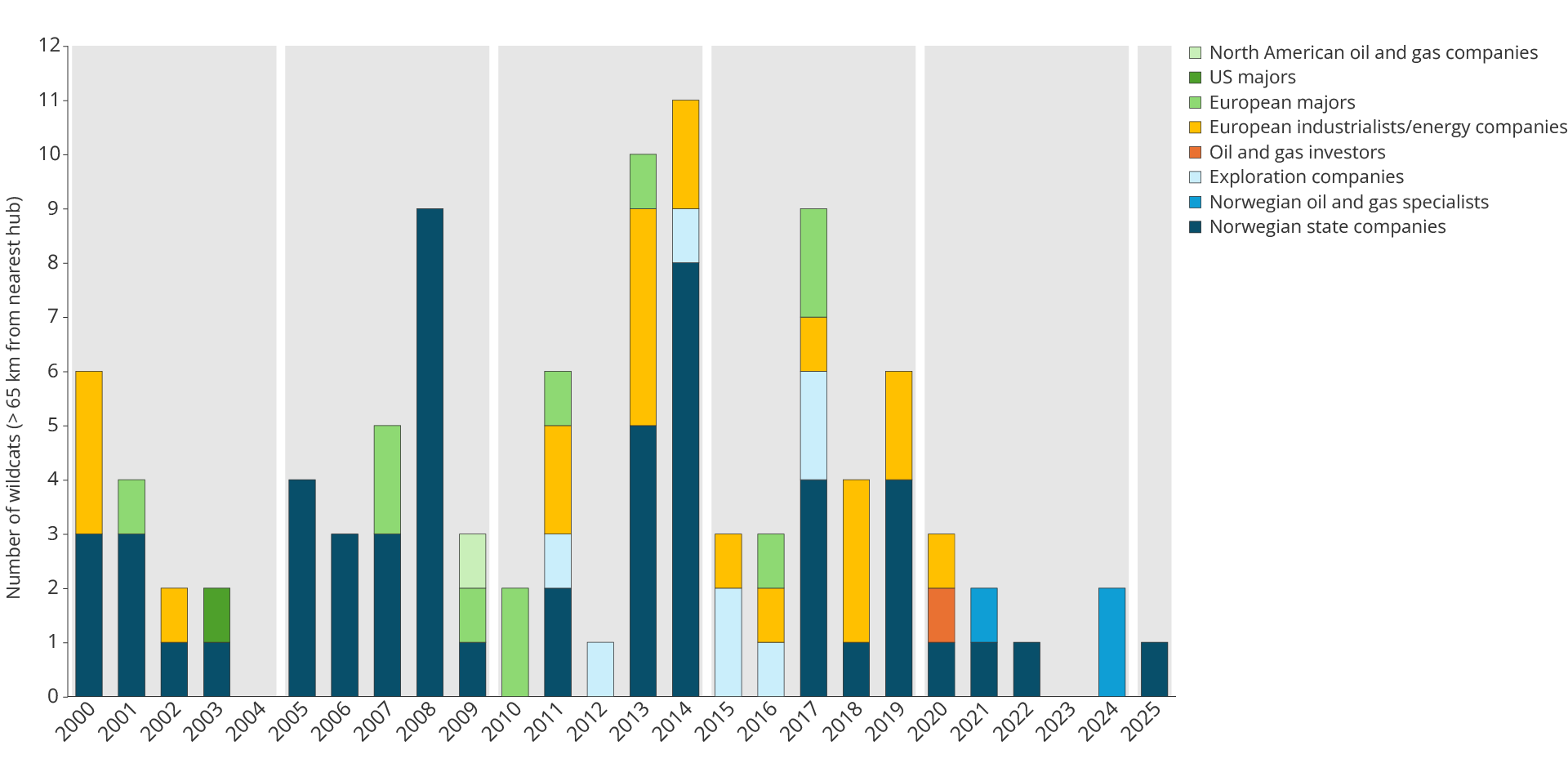
Figure 5.8 Exploration wells spudded at a distance > 65 km from the field centre, by company categories (operators)
Near-field exploration helped to maintain the level of activity but yielded few major discoveries (see Figure 5.9).
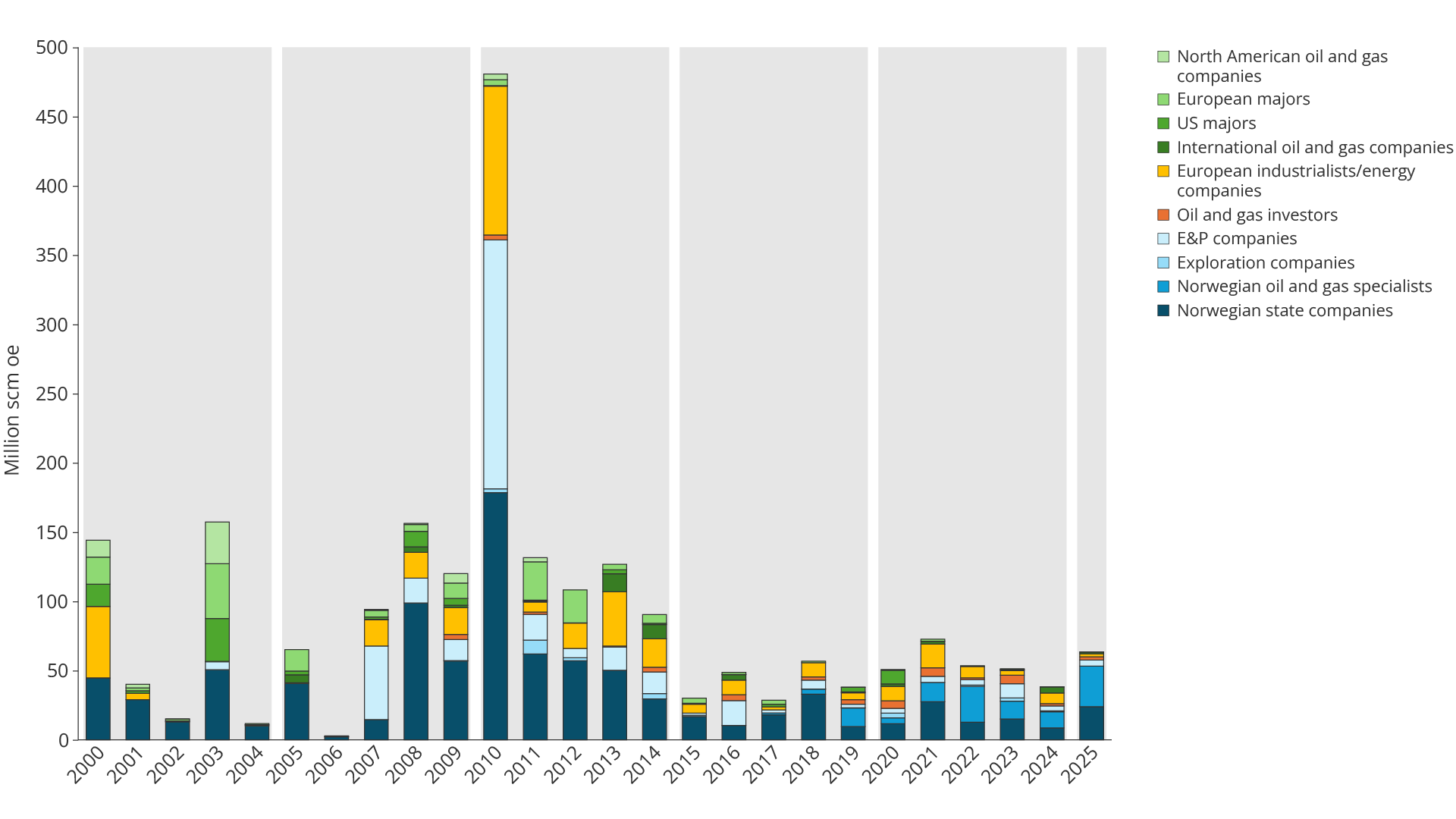
Figure 5.9 Annual discovery volume 2000–2025 (licensees)
The crisis led to consolidation among both small and medium-sized companies, whilst several large international companies withdrew from the NCS. As a result, the medium-sized companies have taken on an increasingly important role in the further development of the shelf.
Development and operation phase
The fall in oil prices led operators to reduce cost levels in both projects and operations. The largest project in the period was the development of Johan Sverdrup. The field was approved for development in 2015, with Equinor as operator and Lundin, Petoro, Det norske oljeselskap and Maersk as partners. The first development phase started production in October 2019 and was carried out within planned cost and time frames, and at a lower development cost per barrel than previously estimated.
In the operational phase, the most important structural change was the emergence of new and medium-sized operators, whilst several large international oil companies diminished their presence. Vår Energi was established in 2018 through the merger of Eni's Norwegian portfolio and Point Resources. In 2019, Vår Energi acquired ExxonMobil's upstream activities in Norway, after which ExxonMobil exited NCS. Shell and ConocoPhillips divested on the NCS in line with their global portfolio optimisations. The player landscape thus became more consolidated and more Norwegian-dominated.
2020–2024: The energy trilemma and Norwegian dominance
The period started with the Covid-19 pandemic, which led to a sharp fall in oil prices to USD 20–30 per barrel in the spring of 2020. The Norwegian authorities introduced temporary changes to the petroleum tax system to maintain investment activity and ensure companies' access to capital.
At the same time, international attention to climate risk and the energy transition gathered pace. The risk of depreciation in fossil resources became more important in investment decisions. This affected the player landscape differently from the oil price slump of 2014–2015.
The exploration phase
Increased focus on greenhouse gas emissions and stronger pressure from capital markets contributed to the remaining large international oil companies reducing their activity on the Norwegian shelf. A lack of materiality in ownership positions and in future opportunities was also important. As a result, exploration activities were increasingly dominated by specialised Norwegian and medium-sized European companies.
Aker BP emerged, particularly following the takeover of Lundin's operations in 2022, as one of the leading exploration players on the NCS, in addition to Equinor.
Development and operation phase
Production levels were high in the first half of the 2020s. Production from Johan Sverdrup and several new development projects helped to lift total production.
Aker BP became Norway's second largest operator, measured in production and resource base. The development of the Yggdrasil project, which incorporates the Fulla, Munin, Hugin and Hugin satellite fields, is the company's largest ongoing operator project and among the most significant developments on the NCS during the period.
In the operations phase, companies specialising in mature fields became more important. These players bought interests in producing fields which larger companies chose to divest. OKEA is one example of this type of player.
Overall, the player landscape in the development and operation phase can be described as more consolidated and increasingly Norwegian-dominated. Equinor, Aker BP and Vår Energi made up the majority of the operators, while Petoro, as manager of the SDFI, is a significant licensee. Norwegian companies thus held a stronger role in this phase than ever before.
2025: More Norwegian and more consolidated than ever
In 2025, the NCS appears more consolidated and Norwegian-dominated than previously. Equinor, Aker BP and Vår Energi are the most active operators in both the exploration and development and operations phases. The development in licensed acreage for operators from 2000–2025 is illustrated in Figure 5.10.
Figure 5.10 Production licences by company categories (operators) from 2000 to 2025
In the exploration phase, the Norwegian companies account for most of the activity.
The review of the period 2000–2025 shows increasing differences between the exploration phase and the development and operation phase. In the exploration phase, changes to the regulatory framework lowered the threshold for new entrants, particularly through the exploration reimbursement scheme and the APA scheme. Along with oil price developments, this contributed to a diverse player landscape and a large number of active companies on the NCS up to 2014.
In the development and operation phase, the entry barriers are higher. Operator responsibility requires financial strength, technological capacity and organisational robustness, which only a limited number of companies have. Equinor has played a leading role throughout the period, while the growth of Aker BP and Vår Energi is an important trend.
This trend is mainly driven by consolidation, rather than organic growth. Companies that have divested have transferred significant numbers of employees and activity to players such as Aker BP and Vår Energi.
The player and resource landscape 2025
Norwegian players have a large share of both reserves and resources. Figure 5.11 shows remaining reserves and resources distributed by different player groups.
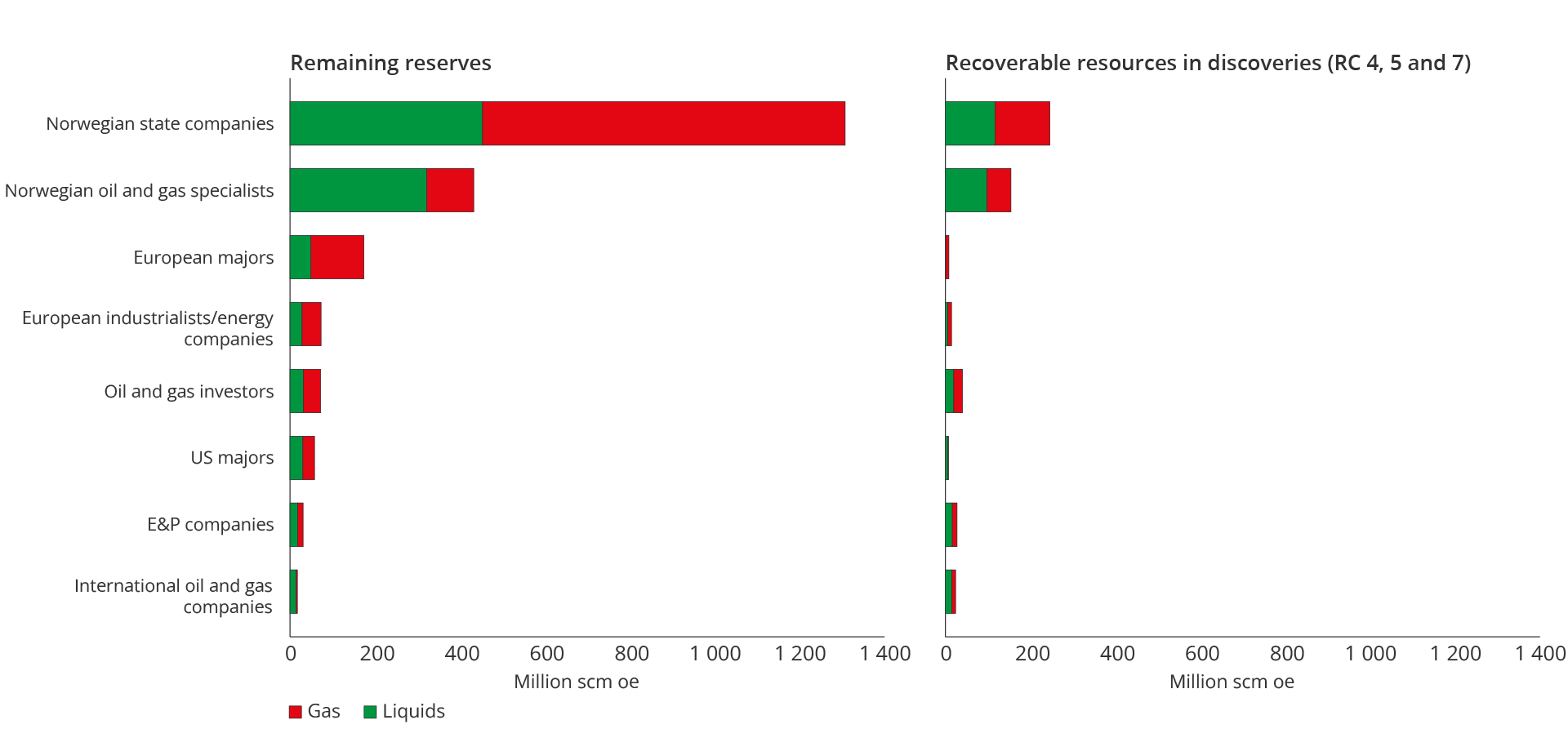
Figure 5.11 Remaining reserves and resources in discoveries by company category as of 31.12.2025
Figure 5.12 shows the development in remaining reserves and resources distributed by companies over time.
Figure 5.12 Remaining reserves (RC 1–3) and resources (RC 4, 5, 7F) per company between 2001–2025 (ten largest).
Diversity in the player landscape
The exploration phase
In the exploration phase, diversity has been important for efficient exploration of the shelf. Historically, the framework has facilitated various geological assessments, which has contributed to discoveries also in areas previously relinquished.
Johan Sverdrup represents the best documented case. The discovery was made after established companies had given lower priority to the Utsira High based on the prevailing interpretive framework(37).
This proves that areas are assessed differently by different players, and that a breadth of professional approaches is important in order to prove as many resources as possible. Nevertheless, diversity of ideas does not necessarily follow directly from the number of players (see fact box).
Different forms of diversity in exploration
Player diversity
Player diversity means that companies with different strategies, risk tolerance and professional communities participate in exploration activities. On the NCS, this diversity has been reduced since several large international companies elected to withdraw. At the same time, consolidation has led to fewer specialised exploration companies, which have historically contributed with alternative geological assessments. Lundin is a prime example.
Methodological and ideological diversity
Several important discoveries on the NCS have come about due to breakdowns in established geological consensus, including Edvard Grieg and Johan Sverdrup. Such discoveries require that the companies have the risk appetite to test alternative geological hypotheses by drilling exploration wells. The challenge arises when divergent hypotheses are not tested in practice.
Financial diversity
Financial diversity refers to the participation of players with different time horizons, risk appetite and access to capital in exploration activities.
Development and operation phase
In the development and operation phase, a large number of players can strengthen competition, but can also make coordination and commercial negotiations more demanding.
At the end of 2025, 9 of the 23 companies on the NCS were operators in the development and operation phase. Figure 5.13 illustrates the total production by operator.
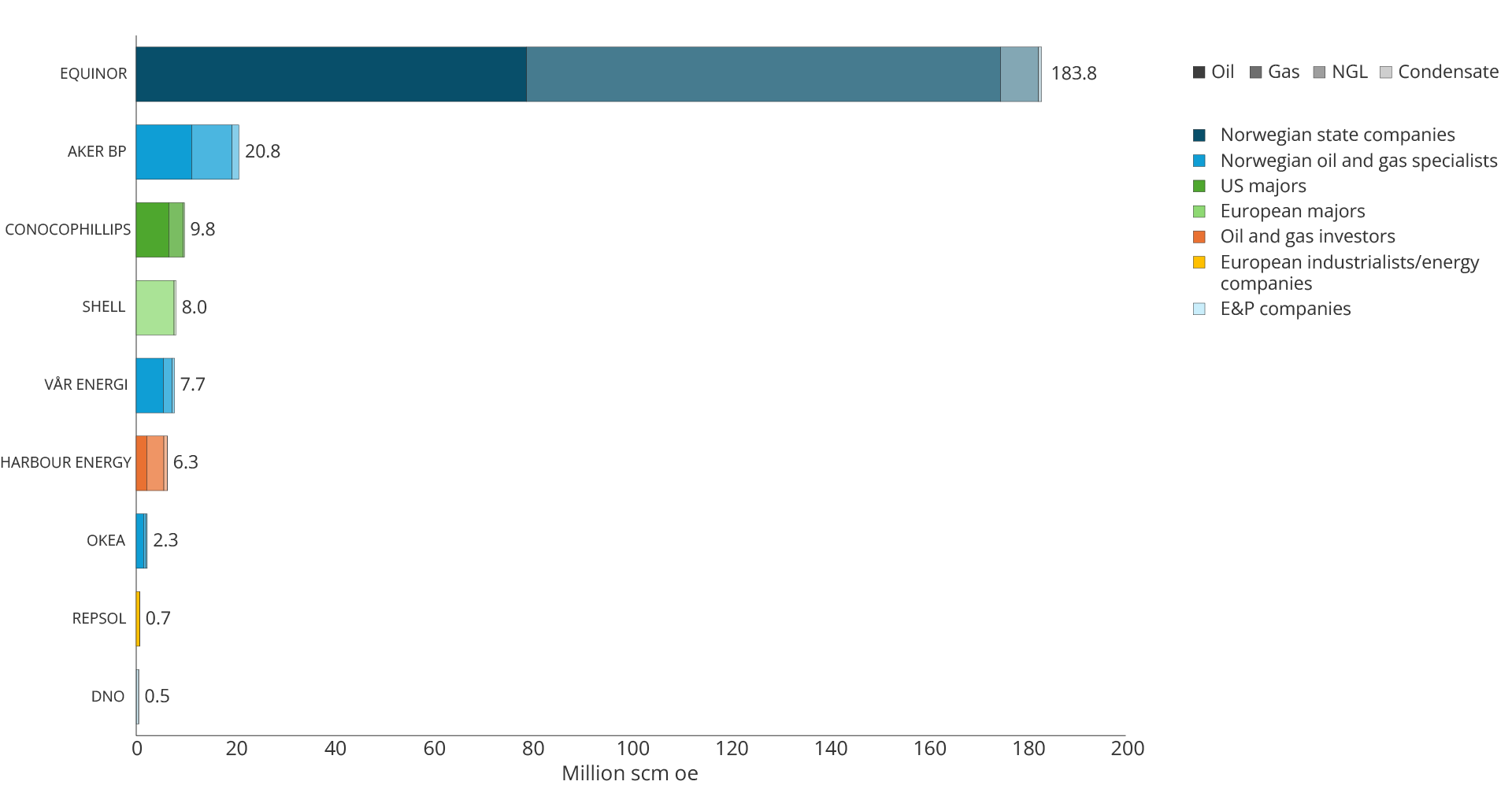
Figure 5.13 Total production by operator in 2025. The volumes are not adjusted for the operators' ownership interests, but reflect total production of the fields which the companies operate.
The figure illustrates that the Norwegian operators dominate. They accounted for a total of 89 percent of production in 2025.
The challenge ahead is not primarily the number of players, but ensuring that the diversity of geological assessments, risk approaches and time horizons is sufficiently large. This, coupled with healthy competition, is crucial to realising the potential in those parts of the shelf remaining to be explored and developed.
Updated: 9/8/2026