

Three scenarios up to 2050
The development of the NCS up to 2050 is uncertain. It is influenced by global circumstances and drivers specific to the NCS. Key factors include a decline in production on mature fields, willingness to invest, exploration activity and technological development. Seen as a whole, this creates ample scope to act and pursue opportunities, which in turn forms the basis for the Norwegian Offshore Directorate's scenarios.
Scenarios for production development
The Norwegian Offshore Directorate has developed three scenarios for production on the NCS up to 2050. Together, they depict a broad spectrum of potential production outcomes. All three point towards a decline in production over time, but the pace and extent of the decline vary.
The scenarios show neither an upper nor a lower limit for future production. A higher resource base than expected, sustained high prices, technological breakthroughs or the opening of new areas can increase the likelihood of higher production than that illustrated. Similarly, persistently low prices and low willingness to invest may reinforce the trend towards less exploration, lower resource growth and lower production.
Scenarios – Methodological Framework
Scenarios are neither forecasts nor recommendations. The Norwegian Offshore Directorate’s scenarios describe plausible and consistent future pathways for the NCS. Each pathway shows how different combinations of willingness to invest, exploration activity and technological development may influence the decline in production.
The scenarios have been developed by combining the most important and uncertain drivers of production development on the shelf to create plausible and consistent future pathways. For each scenario, production profiles have been established for fields, discoveries, improved recovery and contributions from exploration.
The production profiles are based on the companies' reported data to the Revised National Budget (RNB) and the Norwegian Offshore Directorate's expected estimate for undiscovered resources in areas opened for petroleum activities. In the High scenario, technological development means that volumes not currently included in the Directorate's resource accounts become technically and commercially recoverable.
Modelling of new discoveries
The production profile for new discoveries from undiscovered resources is based on assumptions about exploration activity, discovery success and lead time. For each discovery, a development solution and associated cost and production profile are assigned.
The development solutions are based on typical concepts, either as stand-alone developments or satellite developments. The production and cost profiles consider resource size, reservoir depth and distance to infrastructure. The cost level is based on historical experience and assessments of future development.
Only projects with a positive net present value (NPV) are included in the production profile. As production declines towards 2050, increased consolidation of infrastructure is assumed to keep unit costs down.
Market development and price assumptions
All scenarios are based on the assumption that only profitable resources are produced, using technical calculation prices for oil and gas prepared by the Ministry of Energy.
The development in production in the three scenarios is outlined in Figure 2.1.
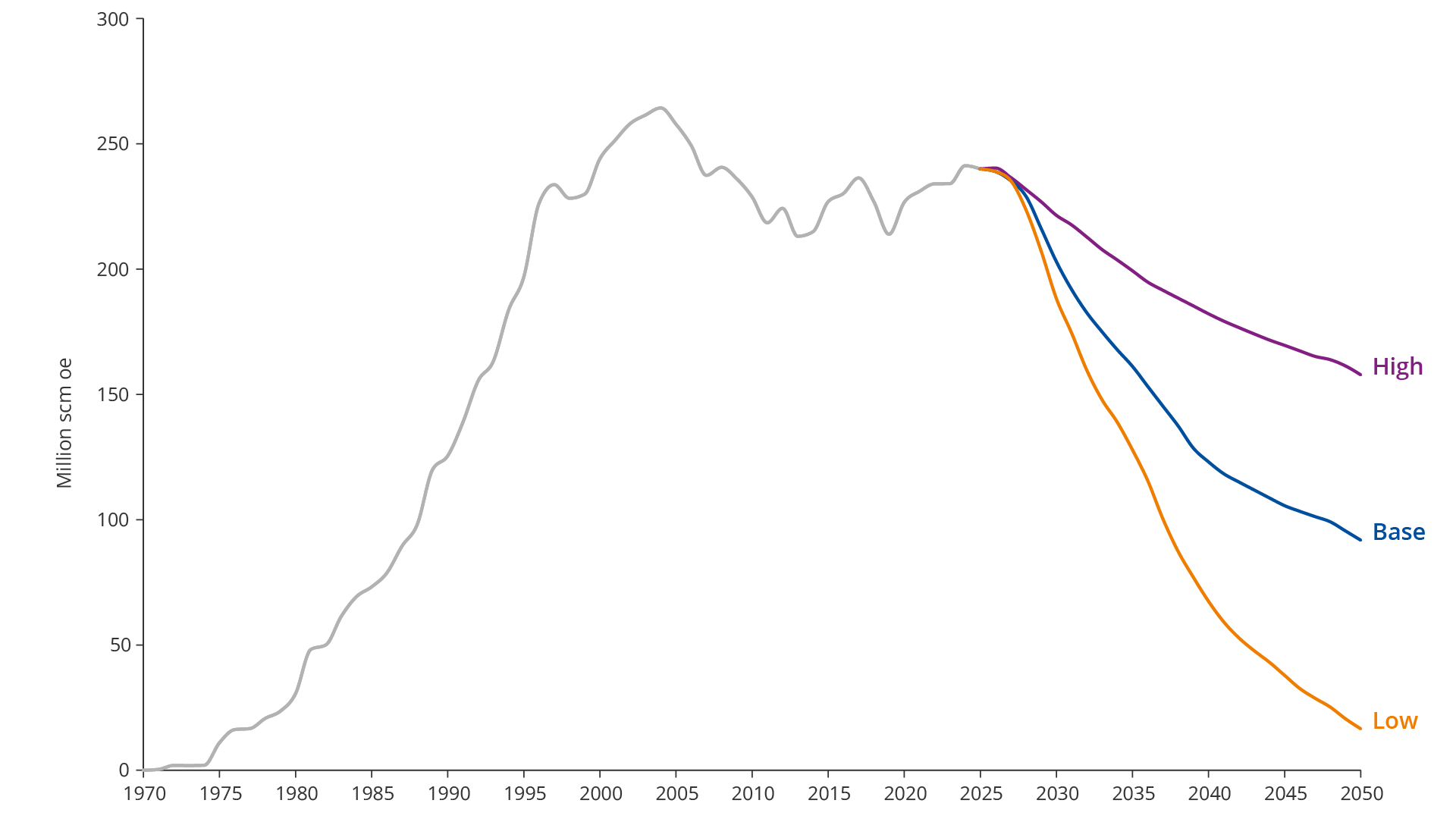
Figure 2.1 Three scenarios for production development on the NCS up to 2050.
The scenarios Base and Low largely correspond to the presentations in the Resource Report 2024. The High scenario, on the other hand, has a somewhat different profile in this report. Large discoveries in the Norwegian Sea and the Barents Sea are made later, while several medium-sized discoveries are made early in the period.
Low scenario
The Low scenario (Figure 2.2) is characterised by low willingness to invest, limited exploration activity and weak technology development. Overall, this leads to a rapid decline in production up to 2050.
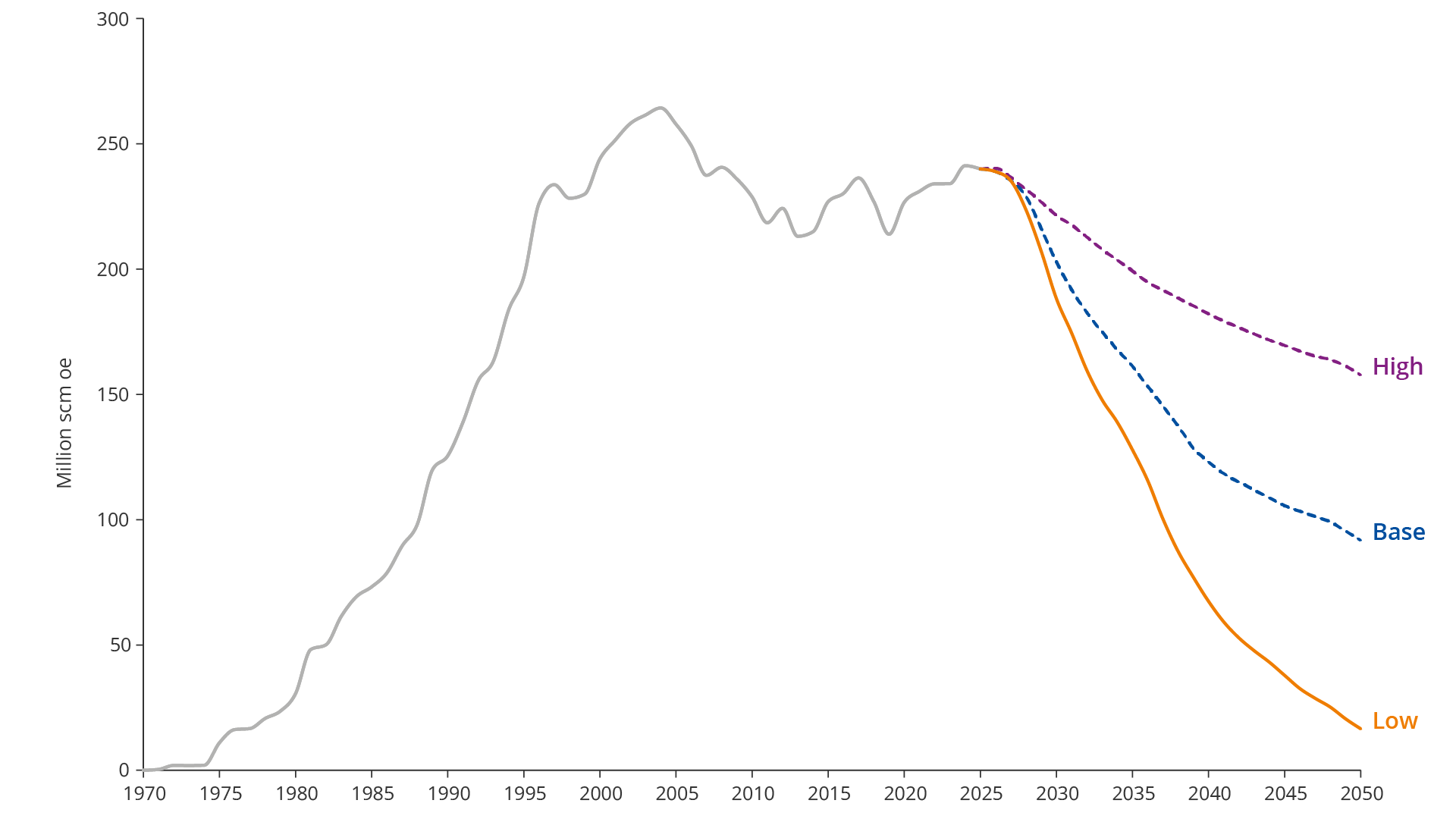
Figure 2.2 Low Scenario
Production falls from approximately 240 million scm oe in 2025 to approximately 15 million scm oe in 2050. This is reflected in a rapid and extensive decommissioning of petroleum activities on the NCS.
Exploration activity remains close to current levels for the first few years, declining rapidly thereafter. Most of the wells are dry, and few discoveries are commercial. Increased export capacity for gas from the Barents Sea is not established, and exploration in the area yields few profitable discoveries. Activity is concentrated in the North Sea and the Norwegian Sea, where discoveries are generally small.
Few new discoveries are developed, and those that are realised are too small to maintain high capacity utilisation in host fields, pipelines and processing plants. Few projects are initiated to improve recovery. Unit costs rise rapidly, profitability weakens and many fields are shut down early. This triggers a domino effect in the infrastructure, thus amplifying the drop in production.
Base scenario
The Base scenario (Figure 2.3) is characterised by a strong willingness to invest, relatively high exploration activity and moderate investments in technology. Overall, this contributes to curbing the decline in production up to 2050.
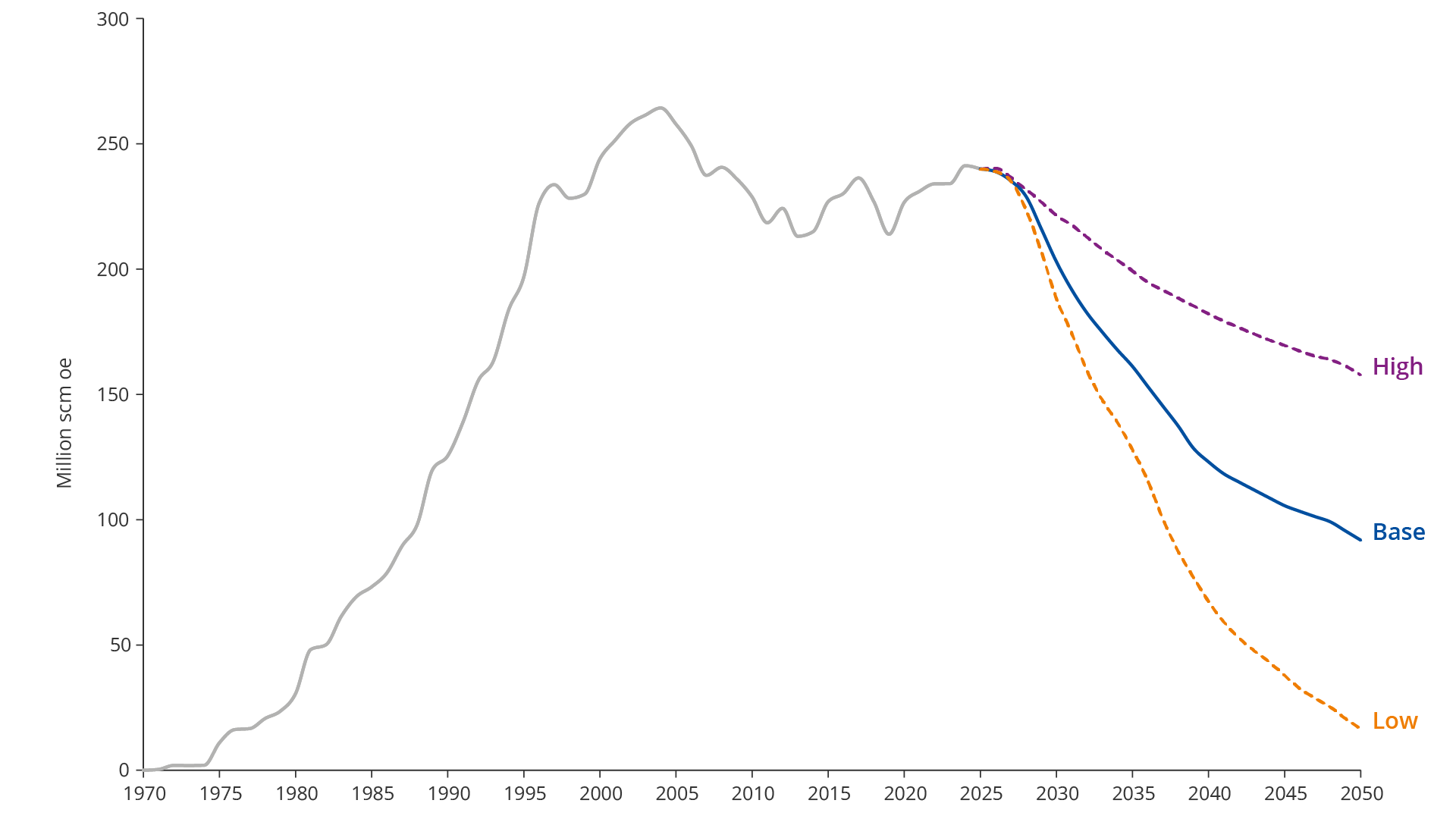
Figure 2.3 Base scenario
Production is reduced gradually from approximately 240 million scm oe in 2025 to approximately 90 million scm oe in 2050. The resource growth from exploration activities is not sufficient to compensate for the decline in production from the large fields.
Exploration activity remains approximately at current levels for the first few years but gradually declines further during the period. Activity is highest in the North Sea and the Norwegian Sea, where access to infrastructure with spare capacity secures a short lead time from discovery to production.
Developed discoveries help to maintain capacity utilisation and keep unit costs down. Increased gas export capacity is established in the Barents Sea. In the medium and long term, the proportion of exploration wells in this area increases.
The companies invest in improved recovery, extending the lifetime of existing fields. Most new discoveries are profitable and developed as satellites to existing infrastructure.
Technology development is sufficient to support further operation and development, but not to counteract the structural decline in production.
High scenario
The High scenario (Figure 2.4) is characterised by high exploration activity, many discoveries and strong resource growth, including from tight reservoirs. Rapid technological development and implementation, combined with companies willing to invest, help to keep production at a high level over time, even if it declines gradually towards 2050.
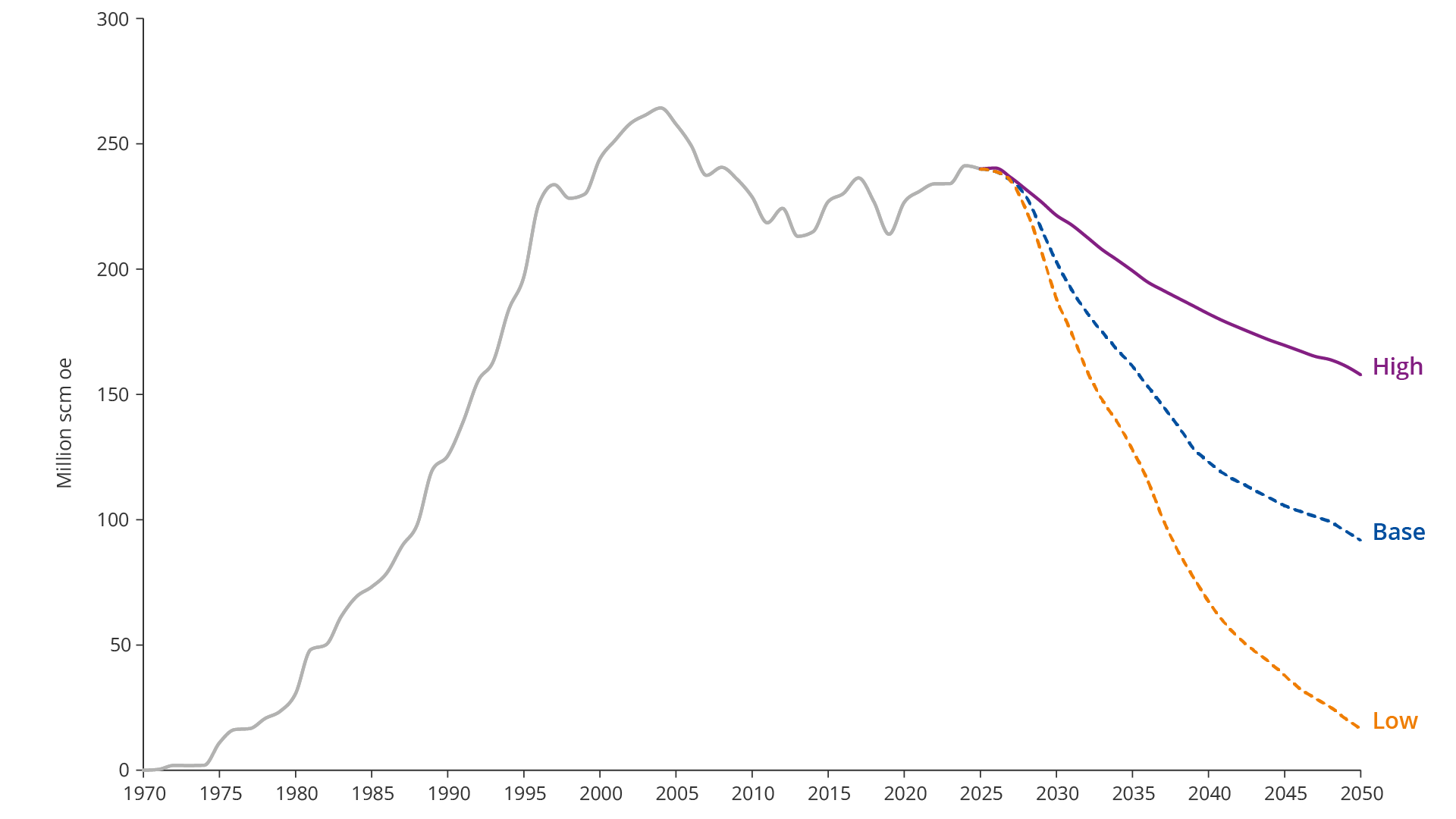
Figure 2.4 High scenario
Production is reduced from approximately 240 million scm oe in 2025 to approximately 160 million scm oe in 2050, corresponding to 66 per cent of current levels.
Exploration activity is high throughout the period. In the first part, exploration is concentrated in areas near infrastructure in the North Sea and the Norwegian Sea, where spare processing capacity secures a short lead time from discovery to production. Advanced seismic data and artificial intelligence increase exploration accuracy, reduce the proportion of dry wells and contribute to falling costs per discovery. Even relatively small discoveries are profitable and are developed as satellites to existing fields.
In the Norwegian Sea and the Barents Sea, several medium-sized discoveries are made and developed in a coordinated manner as stand-alone projects, helping to sustain production through the 2030s. Early establishment of new and significant gas export capacity from the Barents Sea increases the attractiveness of exploration in the area. This triggers increased exploration activity leading to several major discoveries, particularly gas discoveries, in less mature areas of the Barents Sea.
Rapid technological development makes new resources commercially recoverable. The combination of horizontal drilling and hydraulic fracturing, adapted to Norwegian conditions, enables gas production from tight reservoirs in the Norwegian Sea and the Barents Sea. Moreover, developments in drilling, subsea technology, longer tie-backs and subsea compression reduce costs and extend the lifetime of existing gas fields.
Advanced computing, digital twins and new injection technologies, such as CO2 and polymer injection, improve reservoir understanding and increase recovery rates in selected fields. On large fields, even moderate improvements can be equivalent to the resources in several new discoveries. Investments in technology will therefore be crucial to maintaining production at a high level over time.
Technology megatrends towards 2050
The Copenhagen Institute of Future Studies (5) has, on behalf of the Norwegian Offshore Directorate, mapped six technological megatrends and assessed how these may affect exploration and production on the Norwegian continental shelf up to 2050. The trends reinforce mutually and point collectively to what the report refers to as ambient intelligence: a technological platform where large segments of the business operate more independently.
Artificial intelligence (AI) and automation are the single trend with the greatest direct impact. In the exploration phase, AI significantly reduces time spent on and costs related to seismic interpretation. The technology also provides an improved basis for decision-making on drilling, as well as a higher discovery rate. In the production phase, AI facilitates more autonomous operating models, where digital systems monitor and optimize facilities in near real-time. However, assessments are sober: realistic gains at an operational level are estimated at 5–10 per cent lower maintenance costs. Artificial general intelligence (AGI) is considered a structural uncertainty that could change investment assumptions provided the technology matures in the period 2040–2050.
The Internet of Things (IoT) and digital twins provide the NCS with an increasingly dense sensor network. This enables both more efficient exploration through enhanced reservoir understanding, and more precise production management through predictive maintenance and remote control. Digital twins at the equipment level are relatively mature, while full-scale reservoir twins remain less developed. Integration with older infrastructure and varying data quality are key limitations.
Developments in network technology provide increased capacity and new functions: 5G has already been deployed offshore, while 6G is expected around 2030. With 6G, the centre of gravity is shifted from pure communication to sensing, where the network provides continuous data collection to digital twins. Satellite-based solutions provide better coverage for remote fields, including in the Barents Sea.
Cloud and edge computing is already operational on the NCS and supports both exploration and production processes. The report also highlights a geopolitical and security dimension. The Norwegian National Security Authority (NSM) believes that dependence on the American tech giants is a potential risk, partly due to US legislation on data access.
Quantum sensing and quantum computing have different time horizons. Quantum sensing for mapping the subsurface is approaching commercialisation and may reduce the proportion of dry wells, particularly in underexplored areas. Quantum computers for reservoir simulation are less mature and are not expected to surpass traditional high-performance computing until 2035–2040 at the earliest. Post-quantum cryptography is referred to as an imminent regulatory requirement.
In the area of sustainability technology, the Norwegian continental shelf's already low emissions are highlighted.
Revenue and value creation
The scenarios show a considerable difference in future revenues and value creation from the petroleum industry. The analysis is based on two price trajectories: one in which all three scenarios use a base price of USD 80 per barrel, and one in which the High scenario uses USD 100 per barrel and the Low scenario USD 60 per barrel.
At the base price, the difference in undiscounted net cash flow between the High and Low scenarios is approximately NOK 7,400 billion. With a high price in the High scenario and a low price in the Low scenario, the corresponding difference is NOK 15,200 billion, see Figure 2.5.
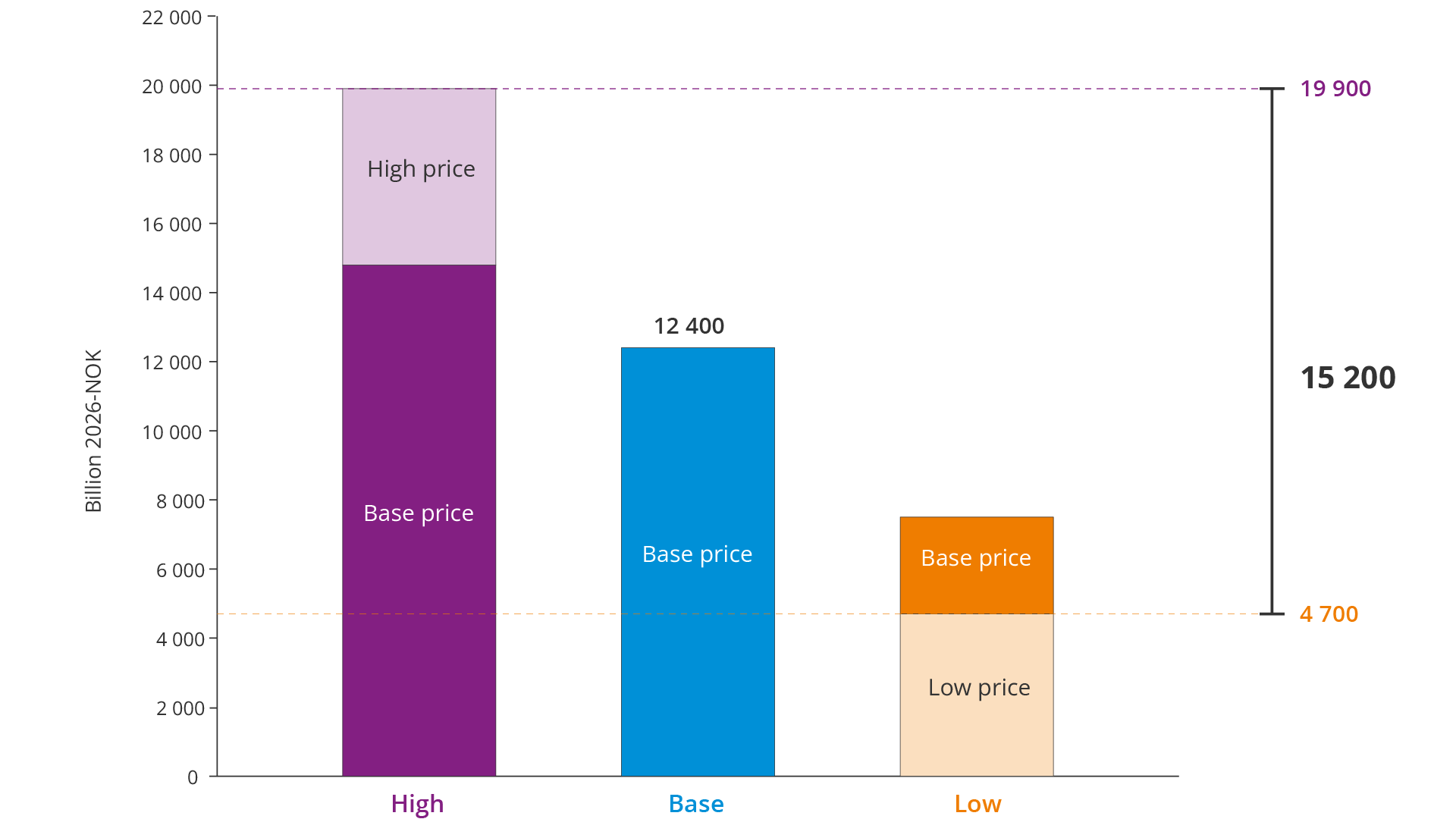
Figure 2.5 Technical estimates for net cash flow (undiscounted)
The net cash flow is discounted using a real discount rate of 4 percent (6), see Figure 2.6.
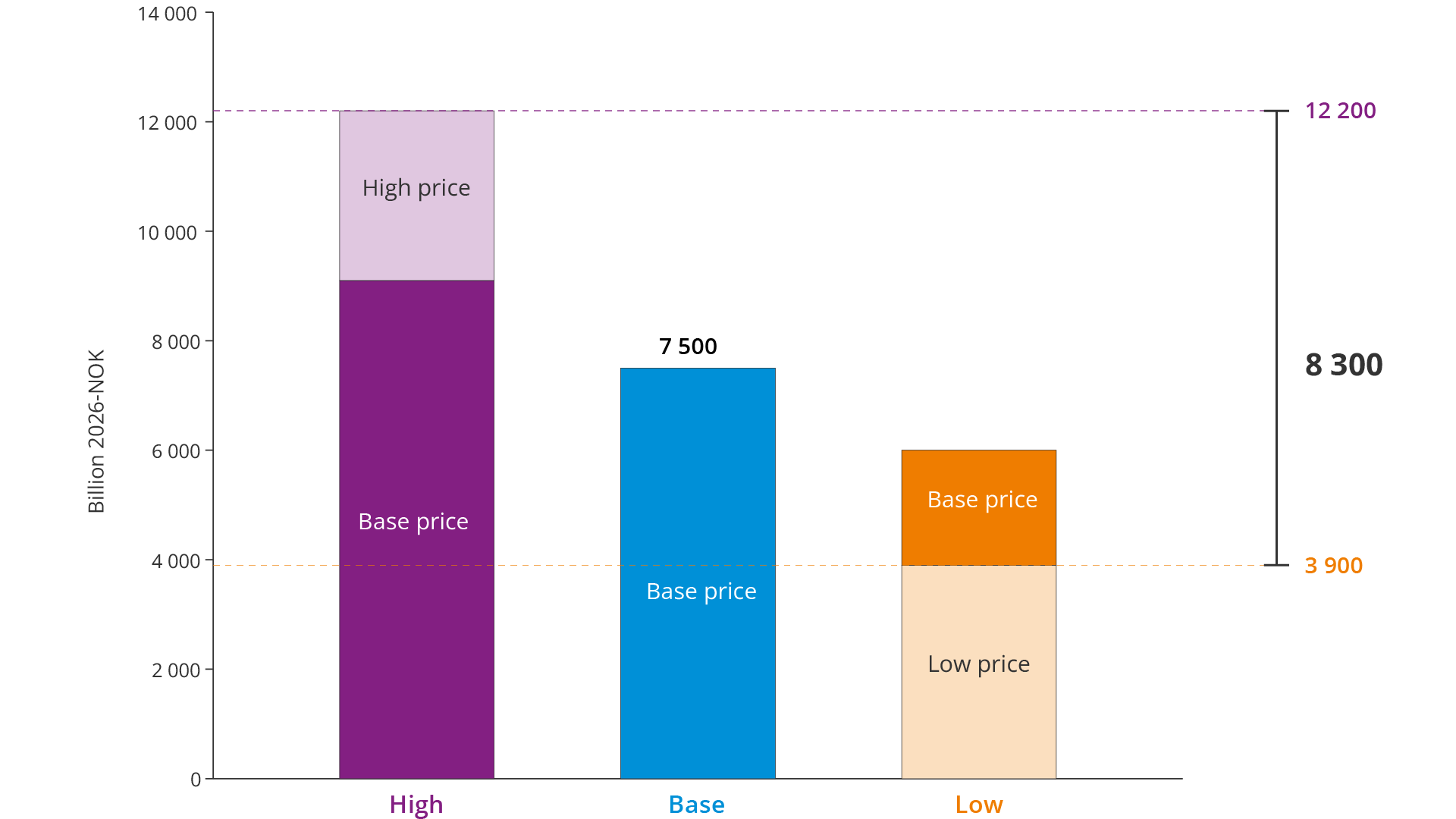
Figure 2.6 Technical estimates for net present value
At the base price, the difference in net present value between the High and Low scenarios is approximately NOK 3,200 billion. With a high price in the High scenario and a low price in the Low scenario, the corresponding difference is NOK 8,300 billion.
Updated: 9/8/2026