
Abstract
The Norwegian Continental Shelf (NCS) stands at a pivotal moment. As a mature oil and gas province, its remaining resources still hold vast potential for sustained value creation and secure energy supply for decades to come. Yet, without new solutions, production is expected to decline sharply towards 2035.
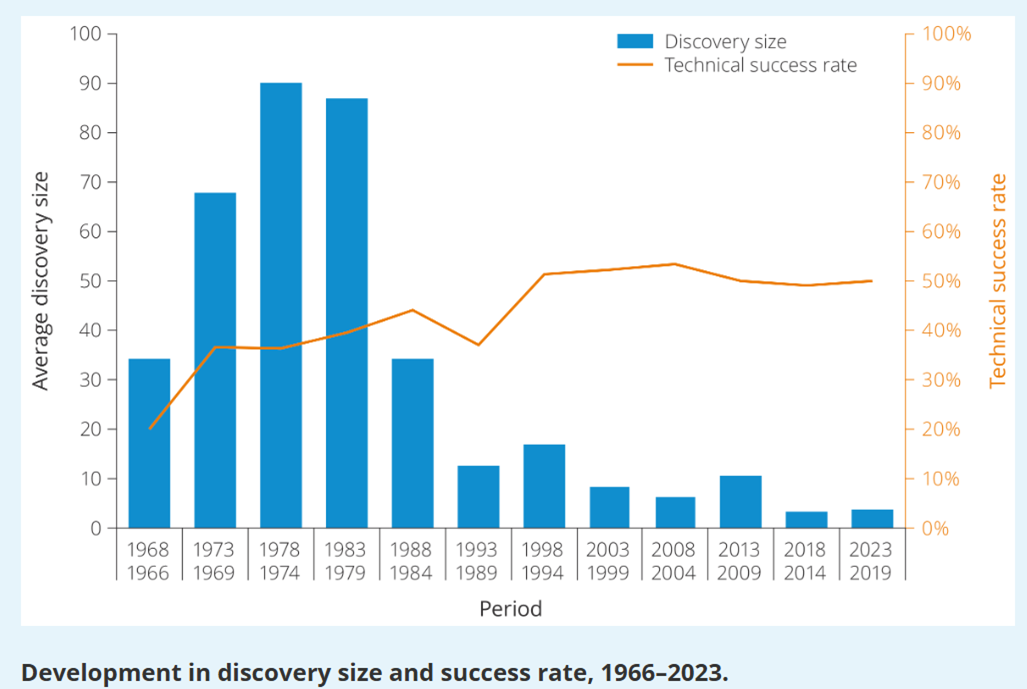
While improved recovery from existing fields remains essential, the next wave of value will come from unlocking smaller and marginal discoveries, often located near existing infrastructure but not only. Across global basins, a consistent trend has emerged: after an era of giant finds, discovery sizes are smaller but more frequent, enabled by advances in subsurface imaging, digitalization, and field development technology. On the NCS, the economic development of these resources, primarily through efficient subsea tiebacks and infrastructure-led exploration, will define the coming decade.
The challenge (and opportunity) lies in turning these smaller discoveries into profitable developments. This requires innovation in subsurface characterization, technology, collaboration models, and commercial frameworks. Equally important is a shift towards improved uncertainty management and a more adaptive risk philosophy. In many smaller discoveries, where P90 volume scenarios are close to neutral or even negative economic outcome and limited appraisal drilling is feasible, decisions must balance material uncertainty with time critical opportunities for tie-in. Success will depend on embracing smarter, data driven approaches to uncertainty, flexible development concepts and commercial models that can thrive under higher technical and commercial ambiguity. Timing remains critical: the economic window for tie-ins narrows as host fields mature and production costs rise.
This high-profile FORCE event will bring together subsurface professionals, front-end and project engineers, economists, managers, and senior leadership from operators, suppliers, and regulatory bodies to explore how the industry can collectively unlock this potential.
Through panel discussions, case studies, and interactive dialogue, the event will:
- Examine the key challenges and success factors in marginal field development
- Share technical and commercial strategies for improving the economics of small-field developments
- Showcase success and failure stories & lessons from operators who have delivered profitable and challenging tiebacks and incremental recovery projects
- Identify collaboration and policy levers to accelerate sustainable value creation
With the future of the NCS increasingly dependent on smaller and marginal developments, this workshop aims to spark the cross-disciplinary innovation and leadership required to turn these opportunities into lasting value.
Back to main page
Updated: 1/9/2026