Sokkeldirektoratet

Further emission cuts from the Troll field
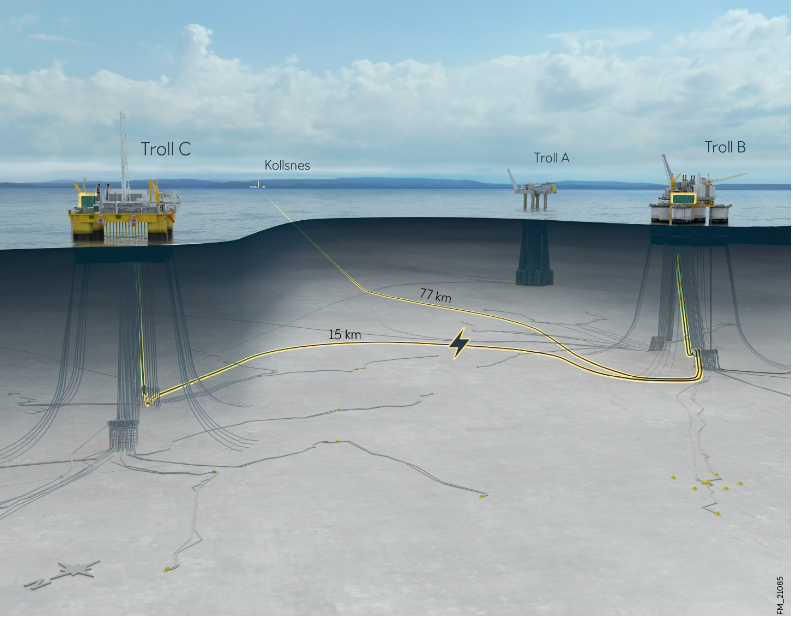
The Troll field in the North Sea will become nearly fully electrified using power from shore in 2026 (Illustration: Equinor).

4/23/2021 Once Troll Vest in the North Sea is hooked up to receive electric power through cables from shore in 2026 (Troll B partial, Troll C complete), this will result in emission cuts of 466,000 tonnes of CO₂ each year, according to statements by operator Equinor in a new plan for development and operation (PDO), submitted Friday.

This emission cut is equivalent to around one per cent of total emissions in Norway (around 50 million tonnes).

Troll A was the first platform on the Norwegian shelf to run on power from shore. Until now, Troll B and C have been run on power from gas generators on the platforms.

The work to modify and prepare Troll B is scheduled for completion in the spring of 2024, while Troll C will be ready for power from shore by the autumn of 2026.

The PDO describes the plans to modify the platforms in the North Sea, the onshore facility at Kollsnes outside Bergen and the power cables from Kollsnes out to the field. According to Equinor, the total investment is estimated at 7.9 billion kroner (2021).

Continued electrification of oil and gas fields using power from shore is important if Equinor is to keep its pledge of a 40 per cent emission cut by 2030.

Generally speaking, it is most profitable to electrify fields with long lifetimes (like Troll) and significant emissions, and which are located relatively close to shore.

In good weather, the Troll field can be glimpsed from the Ulriken mountain in Bergen.

Read more about the TROLL-Field

Read the Ministry of Petroleum and Energy press release (in Norwegian only).

Contact

Ola Anders Skauby

Director Communication, public affairs and emergency response

Tel: +47 905 98 519

Updated: 4/23/2021

Latest news

Oil discovery in the North Sea (35/11-32 S)
3/10/2026 Equinor and its partner, INPEX Idemitsu, have discovered oil in the “Byrding C” prospect in wildcat well 35/11-32 S.
Who deserves the Improved Recovery Award?
3/4/2026 There is still time to propose candidates for the award, but the deadline is quickly approaching.
Profitable development of tight reservoirs
3/3/2026 According to a mapping conducted by the Norwegian Offshore Directorate, cooperation between the companies, cost reductions and applying new technology can contribute to profitable production from tight reservoirs.
More oil discovered near Snorre (34/4-19 S)
3/2/2026 Equinor and its partners have discovered oil on the “Omega Sør Alfa” prospect in the North Sea, around 200 kilometres northwest of Bergen.
High production and increase in petroleum resources
2/20/2026 According to the Resource Accounts for 2025, oil production on the Norwegian continental shelf (NCS) in 2025 was the highest since 2009.
Production figures January 2026
2/20/2026 Preliminary production figures for January 2026 show an average daily production of 2 219 000 barrels of oil, NGL and condensate.
Dry well in the Barents Sea (7018/5-2)
2/18/2026 Equinor and its partners have drilled a dry well on the "Vikingskipet" prospect.
Oil and gas discovery and dry well in the North Sea (33/12-N-3 HH and 33/12-N-3 GH)
2/16/2026 Equinor and its partners have discovered oil and gas in the "Granat" prospect near Gullfaks, 190 kilometres northwest of Bergen.
Dry well in the North Sea (25/8-C-23 D)
2/12/2026 Vår Energi and its partner Kistos Energy have drilled a dry well in the Balder area in the North Sea.
Drilling permit for wellbore 25/7-13
1/29/2026 The Norwegian Offshore Directorate has granted Equinor Energy AS drilling permit for wellbore 25/7-13 in production licence 782 S.