3 – Scope Phase
The Scope phase defines how companies maintain and update the scope of projects and resources to be reported.
Content
- 3.1 Editing and Completing the Scope
- 3.2 Project Attributes
- 3.3 Project Milestones
- 3.4 Resource Classification in Projects and Related Problem Areas
The Scope phase is based on clarifications from the Initiate phase, companies shall update last year’s scope to reflect current plans and document changes.
Approval of the scope is a prerequisite for data to be reported to RNB. If discoveries are made after an agreed scope has been established, the resources etc. for these must also be reported. The operator must establish a scope for the discovery as soon as possible and agree on deadlines for data reporting with the Directorate.
If there are significant changes to the reporting due to budget decisions in the production licenses’ management committees after October 15, the Directorate must be contacted immediately to clarify whether an updated report needs to be submitted.
A completed scope ensures consistent reporting objects, deposits and project group structures, enabling efficient data submission and validation. When projects move into or out of this year’s list compared to the last reporting, the information is still required.
Each reporting object (field, discovery and TUF) contains one or several projects. A project in the Norwegian Offshore Directorate’s resource classification system refers to an initiative aimed at developing and producing petroleum resources. Projects are categorized based on their maturity and the level of knowledge about the petroleum volumes involved.
All recoverable petroleum volumes must be assigned to a project. A project represents the connection between a petroleum volume and the decision process, including budget allocation. A project will have a specific level of maturity regarding a decision to whether to proceed (i.e., to invest money). An additional project in a field or a mature discovery can represent development of one or more new deposits, or it can represent a specific measure to optimise production on a field.
Projects also apply to TUF. An additional project can for example be a new pipeline or a new compressor. Each project should be placed in a resource class based on its maturity.
For mutually exclusive projects (targeting the same volume), only the most probable project should be reported.
3.1 Editing and Completing the Scope
Reporting of related deposits is mandatory for projects in RC0 and RC0+1, Project Category F and Project Category A where there is a one-to-one relationship between the project and the deposit.
Our goal is to maintain yearly resource growth both to new and older discoveries, with an ambition to register proven resources per play. A link between the projects and the deposits are crucial for this analysis. When there are multiple deposits behind the project resources, a minimum should be reporting of the major deposit.
We recognize challenges to reporting of deposits for some projects in category A: For instance, an infill well will typically be drilled into one deposit that must be added to the project in scope. While projects such as lifetime extension or low-pressure production will normally affect all producing deposits, and there will not be a relationship between the recoverable volumes in a project and a single deposit. If there are a main deposit, measured in recoverable volumes, we would appreciate such reference in the scope.
All valid deposits per reporting object are available in Collabor8, Initiate/Deposits. If there is a need to change available deposits, name of deposits, discoveries etc. please contact the Directorate in the initiation-stage.
Information to be edited:
- The template contains formatting that guides the user on how to fill in data. For this formatting to work as intended, fill out each row from left to right.
- Reporting dataset must be changed in column B.
- Changes to name or type for the reporting objects, must be updated by the Directorate in Initiate.
- Project Groups may be updated:
- If possible, reuse the same Project Groups as last year’s report.
- Projects in different RC and category cannot be reported in the same project group.
- Generally, all PDO-projects must be reported in separate Project Groups.
- Projects within the temporary 2020-taxation rules must be in separate Project Groups until the Directorate decides.
- Different project types should be reported separately. Commercial projects and Emission projects must be reported separately because they are treated with other validation rules.
- Projects with different DG3 should be reported separately.
- Project Status must be completed for all rows in the list. Please delete old information and enter relevant information from the drop-down menu in the cells.
Please do not delete any project in the template. Cancelled projects or projects included in “Others” must be marked with the proper text in the “Project Status” column.
New projects entered into the list:
- New projects must be entered with the requested information. Give a project name that briefly and as accurately as possible explains what the project represents, and the object information should be copied from other entries.
- All new global identification codes (MasterID) will be created at Offshore Norge.
The table below shows available options for Project Status entries:
Table 2 Available project status entries
| Project Status | Description |
| ContinuedSameRC | The same project, same RC as last reporting |
| ContinuedNewRC | The same project, changed RC from last reporting |
| ContinuedChangeToRC6 | The same project reported last year, changed RC to production not likely |
| NewMeasureFromAnotherProject | New project, with volumes from a project reported last year |
| NewMeasure | New project without integration of volumes from another project reported last year |
| IncludedInOtherProject | Project not to be reported, volumes integrated in another project |
| ProjectCancelled | Project not to be reported, volumes will not be considered |
- If a project is cancelled, please explain the reasons for its cancelation.
- If a project is new to this years’ reporting, a short explanation of the project will be very helpful, as well as the reason behind changing the resource class to RC6.
- If a project is included in another project, information about the integration must be reported under Associated ProjectID. The delivering project must include information about the recipient project, and the receiving project must state the original project from last year’s reporting.
3.2 Project Attributes
For all projects/discoveries in RC3-5, project-specific information shall be provided under the collective heading "Project Attributes" in the template file. It is possible to fill in project attributes for projects/discoveries in RC2, but this is optional.
This information will be used in various analyses the authorities perform regarding the offshore activity. To ensure a uniform basis for the analysis, the project attributes are based on lists with pre-defined selections (drop-down lists). Therefore, only one value can be selected in each cell.
Figure 2 is a view from the Collabor8-RNB template and shows the project attributes that must be completed.

Figure 2 Attributes needed to be addressed as in the Collabor8-template Excel workbook
Project Type: Use this attribute to describe the main method applied to recover the additional volumes reported with Project Category A. This column has an assigned drop-down list.
The table below shows available options for Project Type in Category A.
Note that project types “Commercial agreement” shall be reported regardless of resource class, and it is important to report these projects to avoid unnecessary validation warnings.
Table 3 Options for Project Category A
| Project Type | Description |
| Advanced methods | Improved recovery through advanced methods including CO2 – injection and chemicals injected together with water or gas. Also including other types of water treatment (e.g. low salinity and bacteria/microbial). |
| Change of energy source | Projects on existing field for partial or full replacement of current energy supply. Power from shore, wind turbines or alternative fuels are possible projects for this type. |
| Commercial agreement | Commercial agreements that involve swap/borrowing/deferral of volumes between fields. Please choose this project type regardless of resource class. Not necessary to input other attributes, DG-dates or deposits. |
| Emission Project | The main purpose of ‘Emission Project’ is to report contributions from discoveries expected to be tied into the reporting object but not included in the “Base” emission profiles. Not necessary to input other attributes, DG-dates or deposits. This project type can also be used to report other measures aimed at reducing emissions than changes to the source of energy. |
| Further field development | New facilities to be installed on a field, to optimize recovery or operations as well as prolong field life. May be subject to PDO. The actual facility type must be reported under attribute development solution. |
| Gas/WAG injection | New or increased gas- or WAG injection to increase oil or gas recovery (most likely oil) |
| Late-life production | Prolonged production (and improved recovery) through extension of facility lifetime, e.g., involving modifications, upgrades and/or reclassifications. |
| Low-pressure production | Improved recovery of gas or oil (most often gas) by reducing inlet pressures in the process system through installation of compressors (subsea or topside) or booster pumps etc. and/or reservoir depressurization, also called blow-down. |
| Water injection | New or increased water injection to increase oil or gas recovery |
| Wells | New production wells to optimize recovery |
| Other | When none of the alternatives suits the project. Please enter information as ‘Project Attribute Comment’, column AB in the template-file. When multiple methods are used, please select the main contributor to the volumes stated. |
Project Development Solution: Use this attribute to describe the planned development solution for resources in Category F. If multiple facilities are possible, select the most relevant solution in the table below. This attribute also applies for Project Category A when the attribute, “Further Development” is selected.
More detailed information about assumed development solution can also be provided as free text in ‘Project Attribute Comment’. The table below shows the available options for Development Solutions corresponding to Project Category F:
Table 4 Project Type Options for Project Category F
| Project Development Solution | Description |
| New stand-alone fixed facility | Integrated platform with process facility, e.g., jacket, jack-up, GBS |
| New stand-alone floating facility | Production ship with process facility (FPSO), semi sub, TLP |
| Rental of production facility | Used when the main production facility, normally FPSO or Jack-up, will be leased |
| Sub-sea development to existing facility | New facilities located subsea and connected to existing facilities |
| Well(s) from existing facility | New production or injection wells drilled from existing facility either to infill targets or to undrained segments or prospects |
| Wellhead platform to existing facility | Platform without process facility |
| Other | Used for other specified or unspecified projects that do not fall under other categories. To be specified in ‘Project Attribute Comment’, column AB in the template-file |
Project Power Solution: Many projects will be of such a character that there will be no need to install new power-intensive equipment, and installed capacity must be used. This applies to both field and development projects.
Please state what the most likely power solution will be at project implementation. The table below shows available options for Power Solutions:
Table 5 Project Power Solution
| Project Power Solution | Description |
| Alternative fuels | Power supply based on alternative fuels (e.g., hydrogen, ammonia, biofuels, synthetic fuels). |
| New power generating equipment | Installation of new power generation units on the facility/host facility to increase or replace capacity. |
| Power from shore | Power supplied from the onshore to the offshore installation. |
| Use of existing equipment | No need to install new power generating equipment on the field/ host field/ power plant, as the installed capacity is sufficient |
| Wind turbines | Power supplied by wind turbines (fixed or floating). |
Project Stoppers: Please identify the most obvious condition that may hinder project implementation as reported. For projects with resources in RC4-5 the most important cause for the project not being realized or suffering significant delay should be chosen. The table below shows the available options for Project Stoppers:
Table 6 Project Stoppers
| Project Stoppers | Description |
| Environmental requirements | Realization can entail unacceptable environmental emissions/discharges that with current solutions cannot be removed in a profitable manner. |
| HSE requirements | Realization can entail unacceptable HSE conditions that with current solutions cannot be resolved in a profitable manner. |
| Lack of capacity in existing systems | Realization assumes tie-in to facilities (process facilities, pipelines, land facilities) which do not have available capacity in the relevant period. |
| Lack of infrastructure in the area | Realization requires tie-in to facilities that are not yet in place, physical or contractual e.g. pipelines. |
| No commercial agreement | Realization assumes agreements with third parties, and this is expected difficult to achieve. |
| No gas solution | Realization requires a solution for handling of produced gas, but no profitable gas disposal is available. |
| None | No obvious condition has been identified that could cause a halt or significant delay in the project. |
| Reservoir properties | Low reservoir productivity expected due to acidification/H2S, sand production, etc. which are challenging with the current solutions. |
| Rig availability | No mobile drilling rigs available in the market. |
| Technology is lacking | Realization requires development of new technology. |
| Uncertainty in resource volume | The resource estimate is associated with substantial uncertainty, and more information is required about the size of the deposit before making a decision regarding realization. |
| Other | To be specified in ‘Project Attribute Comment’. |
Project Technology: State whether the project is based on conventional methods or whether new technology will be used or developed. The table below shows the available options for Technology Options:
Table 7 Technology Options
| Project Technology | Description |
| Conventional methods | The project will use technology that is known and commercially available for several years. Once selected, there will be no need for additional input regarding technology areas or status. |
| New available technology | The project involves the use of, or is a result of, new technologies/methods that are currently available commercially/ are fully qualified / recently developed but have not been previously used on the reporting object. |
| Requires development of technology | Realization of the resources in the project is contingent on the development of technologies/methods that are not available commercially today. |
| Other | To be specified in ‘Project Attribute Comment’, column AB in the template-file. |
Project Technology Area: To be reported for other choices than ‘Conventional methods’.
State the areas in which new technology will be used or developed. Provide detailed comments in the comments space, e.g., if the project includes technology development within several areas. The table below shows the available options for Technology Areas:
Table 8 Technology Areas
| Project Technology areas | Description |
| Drilling/well technology | The drilling process, reduced drilling costs, well interventions, completion, etc. |
| Facility/process | Process facility, power supply, environment, integrated operations, subsea facilities/equipment, etc. |
| Production control | Zone control, sand control, water production, etc. |
| Reservoir technology | Injection media, residual oil saturation, reservoir chemistry, etc. |
| Seismic/resource mapping | Advanced seismic methods, 4D, geo-modelling, geo-management, reservoir simulation, etc. |
| Other | To be specified in ‘Project Attribute Comment’, column AB in the template-file. |
Project Technology Status: To be reported for other choices than ‘Conventional methods’.
State the status of technology development for projects that are contingent on new technology.
The table below shows the available options for Technology Status:
Table 9 Technology Status
| Project Technology Status | Description |
| Commercially available | No need for development of technology; available technology will be used. |
| Not started | A need for technology has been defined, but no steps have been taken to start research/development. |
| Undergoing engineering | The owners are aware of/are financing the research/development. |
| Undergoing field testing | The technology is available, but further use depends on the results of pilot tests. |
| Undergoing qualification | Technology has been developed but has not been qualified / is not ready for use. |
| Other | To be specified in ‘Project Attribute Comment’, column AB in the template. |
Project Time Criticality: Is realization of the project time-critical, and if so, what is the time-criticality. The table below shows the available options:
Table 10 Time-critical aspects
| Time-critical aspect | Description |
| Contingent on infrastructure | Time-critical due to limited technical or economic lifetime of facility or time-limited window for process/transport capacity. |
| Contingent on reservoir | Time-critical due to planned gas export and/or accelerated pressure reduction (blowdown) or expected natural depressurization, e.g., in connection with production from adjacent fields (regional pressure drop) which can lead to the loss of resources. |
| Not time-critical | Not critical for immediate action. |
When none of the options fit
In some cases, none of the options in the respective lists will be appropriate for the specific project. The parameter that comes closest should be selected, if not possible “Other” is an option in many of the lists. Please explain in “Project Attributes Comments” when Other is reported. The same applies if several of the choices are equally relevant; select one parameter and, if applicable, list the others in Project Attributes Comments.
The Project Attributes Comment can also be used to provide information e.g., that realization of the project being contingent on specific assumptions, more detailed information about the use of new technology, or technology development needs, and explanations for the decision plan.
3.3 Project Milestones
To ensure that the maturation of projects and discoveries can be followed, the authorities require an overview of the past and expected project decisions within the production licences. The type of decisions made next, indicates the project's progress in terms of studies and evaluations. The figure below illustrates the decision model used by the authorities for larger projects and developments, representing some of the possible selections in the list.
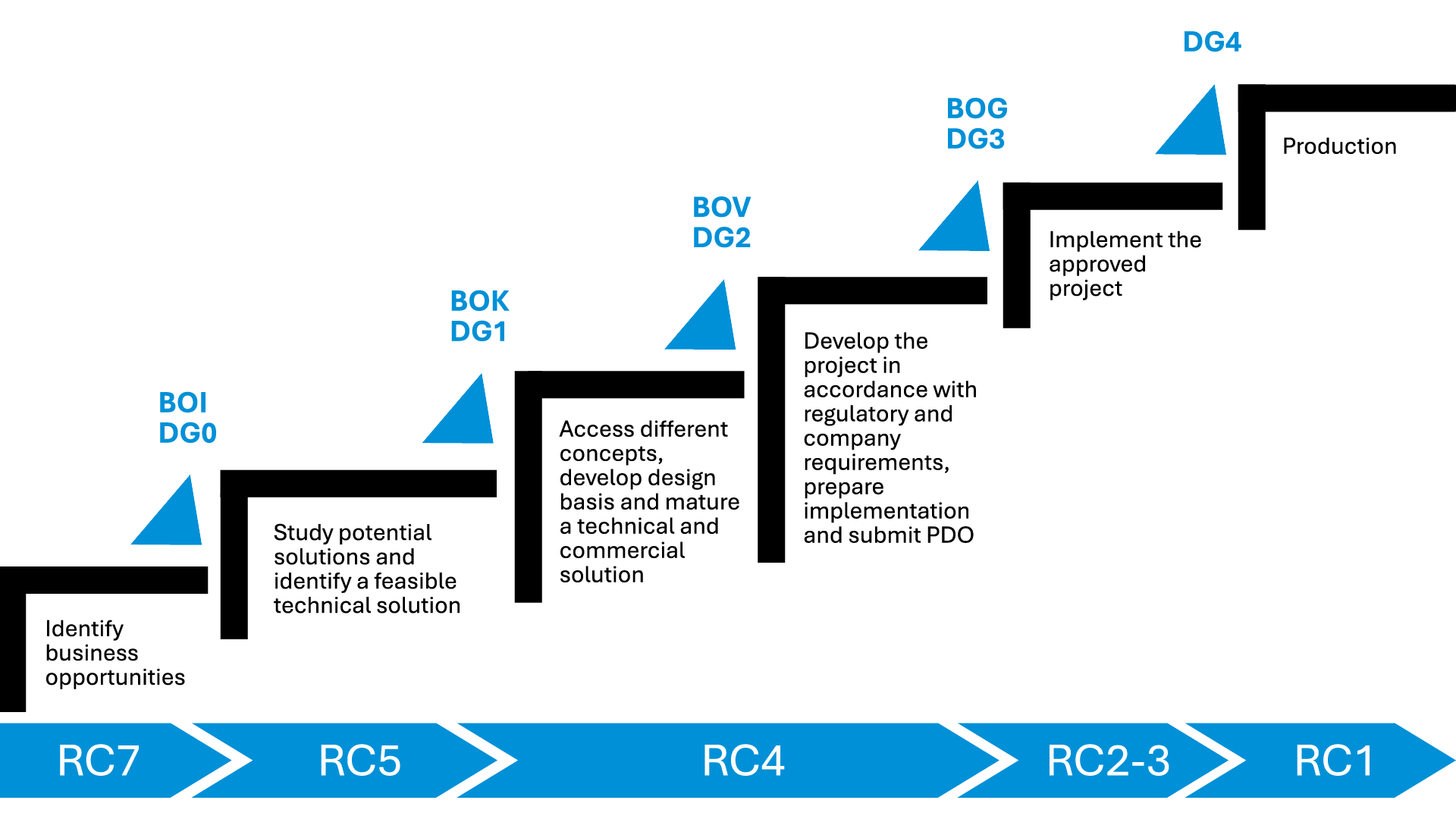
Figure 3 The connection between project maturation and resource classes
Decision Year
- The expected/planned years for future decisions must be indicated. Even if the initiation of the project is quite far into the future, the operator must still provide a year that represents the best estimate. The year selected should be realistic and not just an ambition. Decision milestones that have already been passed should also be stated, including the year.
- Decision on project initiation, BOI (DG 0)
- Equivalent to start-up of feasibility studies. The project is a potential, but evaluation has not yet been started.
- Decision on concretization, BOK (DG 1)
Equivalent to start-up of concept studies. The project is initiated, and feasibility studies are underway. Work is progressing towards a reduced list of concept options. The following activities are normally carried out during the feasibility study phase up to a decision on concretization:
- The concept or resource base for the project is reviewed, evaluated, and described
- The market for the proposed products is evaluated
- Based on technical studies, potential feasible technical solutions are outlined for the field development, transport system, treatment facility, etc.
- HSE consequences are evaluated
- A cost estimate is prepared for the project; this will normally satisfy a range of +/- 40 per cent
- The probable profitability of the business concept will be documented
- An evaluation is made of the uncertainty associated with the project, including resource base, market, technical solution, HSE, feasibility, supplier market, cost estimate and profitability.
- Decision to continue, BOV (DG 2)
- Equivalent to start-up of pre-engineering and concept selection. A cost estimate with reduced uncertainty will be prepared.
- Decision to implement, BOG (DG 3)
- The project is in the engineering phase and final approval by the licensees and submission of PDO (if applicable) is planned. The year will mark when the resources are expected to become reserves. This applies regardless of whether the final decision is submission of a PDO or made in another manner. The selected year should be realistic and not merely reflect ambition. Even if the project is in an early study phase, a year must be entered as the best estimate, given certain assumptions. For discoveries/projects that will be phased into a (parent) facility when capacity becomes available, this should be specified in ‘Project Attribute Comment’, column AB in the template workbook.
- Start-Up (DG4)
- The date when production from a project or the operation of an infrastructure project will start
- DG4Base reflects the expected start-up date
- DG4Early could reflect an ambition start-up date
- DG4Late reflects possible delays that could occur to the project, delaying start-up
- The date when production from a project or the operation of an infrastructure project will start
The DG years should be consistent with the resource class for the profile. Example: volumes from wells classified as reserves, shall have DG1-DG3 when these criteria are met even though DG3 (drilling plan) for individual wells are not yet approved.
3.4 Resource Classification in Projects and Related Problem Areas
Reporting shall be in accordance with the Norwegian Offshore Directorate’s resource classification system. For descriptions and correct use of the classification, use the linked guidelines.
3.4.1 Clarifying Reserves and Contingent Resources
Additional volumes in field projects must be classified either as reserves or as contingent resources.
The following criteria shall be applied to classify projects as reserves:
1. The project is regarded as normal optimization within approved plans, e.g.:
- Better reservoir management
- Improved sweep
- Well maintenance/re-completions
- 4D seismic
- Improvements to existing production facilities
2. Well-projects that have a high probability of implementation, where the following conditions are met:
- Wells can be drilled from an available drilling facility
- Wells can be drilled with available technology
- Wells that are a part of a long-range plan for future activity within areas covered by an approved PDO
The probability of implementation should consider:
- Economy of drilling targets based on expected production, and all costs related to drilling and maintenance of drilling facilities.
- Technical feasibility of drilling with respect to depleted reservoirs, faults, rock mechanical problems, complex reservoirs, and well integrity.
- Availability of drilling facility without additional major investment. For investment in new drilling facility, the completion date of the new facility should be taken into consideration.
- Availability of infrastructure, such as sub-sea installations and risers.
All projects including wells mentioned above shall be reported in resource class, RC 0+1, 2 or 3. Well projects classified as reserves may also be reported separately, as follows:
- RC0+1: Projects with wells in production
- RC2: Projects with wells with approved budget
- RC3: Projects with wells that can be reported as reserves, without approved budget.
Note that wells planned to be drilled, but which do not meet the criteria above, shall be classified as contingent projects in RC 4, 5 or 7.
Examples of other projects with contingent resources on fields include:
- Recovery methods under evaluation or significant expansion of existing recovery methods that will yield extra volumes and a higher recovery factor if implemented (Project Category A), or
- Segments/ parts of the reservoir not currently PDO-approved, and which will yield increased STOOIP/GIIP (project category F), or
- Changes to new form of operation, new or modified facility that will yield higher/accelerated production and possibly also lower costs.
- Projects that will result in significantly longer lifetime for the field.
In all cases, the project must undergo a defined decision process with milestones/decision gates, and costs must be included.
The reserves reported should be considered profitable, based on long-term assumptions regarding product prices and operating costs. Projects where most of the investments are sunk costs should be reported as reserves when total cash flow, including contingent resources, are expected to be profitable.
At some point, continued operation for a field will become unprofitable. Depending on other possibilities for continued operation, the so-called uneconomic tail production should be reported as a contingent project. If there is a reasonable probability for continued operation based on contingent or undiscovered resources, not restricted to current license acreage, this should preferably be reported in RC5A. If more immature, the project should be reported in RC7A.
Blow-down of gas caps on the fields should be reported in a separate project group. This applies to projects that describe a change in production strategy for gas (compression, blow-down, etc.). The reason for this, is the uncertainty of when these projects start. It is therefore useful to receive separate profiles so this can be taken into consideration when the Directorate’s aggregated prognoses are prepared. Therefore, the blow-down projects that are not yet producing, should be reported separately.
3.4.2 Reporting of Commercial Agreements in Projects
When commercial agreements involve swaps/borrowing/deferral of volumes between fields, commercial projects in separate project group must be reported. Please select project type “Commercial”.
The complexity in reporting of commercial agreements varies, and in some situations, sufficient reporting might be possible without the introduction of such projects.
Reporting of commercial agreements should follow these practices:
- Commercial agreements between fields/discoveries should be reported.
- The effects of commercial agreements should be reported as separate projects and project groups depending on number of objects involved.
- To avoid unnecessary feedback in the validation, you should choose “CommercialAgreement” as project type in the attribute area regardless of resource class.
- If a commercial agreement is expected, the commercial effects should be reported. The timing of reporting depends on the availability of the information for the discovery/field at the date of reporting. This is not related to a decision gate (DG) for the discovery. Please indicate whether all parties have agreed to the commercial agreement or if it is in progress in “GeneralDescription”.
- If only one party anticipates the need for commercial agreement, this must be reported. “GeneralDescription” must be used to explain the preconditions for the agreement and the expected host field.
3.4.3 Use of RC6 in Fields and Discoveries
RC6 is used for deposits that, even in the long-term, are unlikely to be developed profitably, and for resources in minor, non-tested discoveries where recovery is not very likely. If the deposit is a supplementary resource to a field, it is reported under the field. Stand-alone discoveries must be reported separately.
Improved recovery measures on fields (Project Category A) that have been evaluated and found to be unprofitable, should not be reported in RC6. If resources can be realized with other measures later, they could be included in RC7A.
3.4.4 Undiscovered Resources in/near Fields and Discoveries
The main rule is that undiscovered, recoverable risked volumes should be reported in RC8. Risked volumes are calculated by multiplying expected recoverable petroleum quantities, given a discovery, by the probability of making a discovery. The total risked volume that lies completely or partly within own licensed area and can be recovered in connection with the field/discovery, shall be reported.
Undiscovered recoverable resources in or near fields and discoveries comprise either prospects or undrilled segments within the field/discovery. Undrilled segments which are not defined as a separate prospect must be included in the volumes for the field/discovery. Prospects which are included in the base case of a submitted PDO or a request for PDO exemption must be reported as discovered resources.
Prospects that extend over the boundaries of a production licence, or into adjoining production licences, are to be reported as total risked volumes.
Updated: 5/29/2026