“New” source rock discovered west of Svalbard
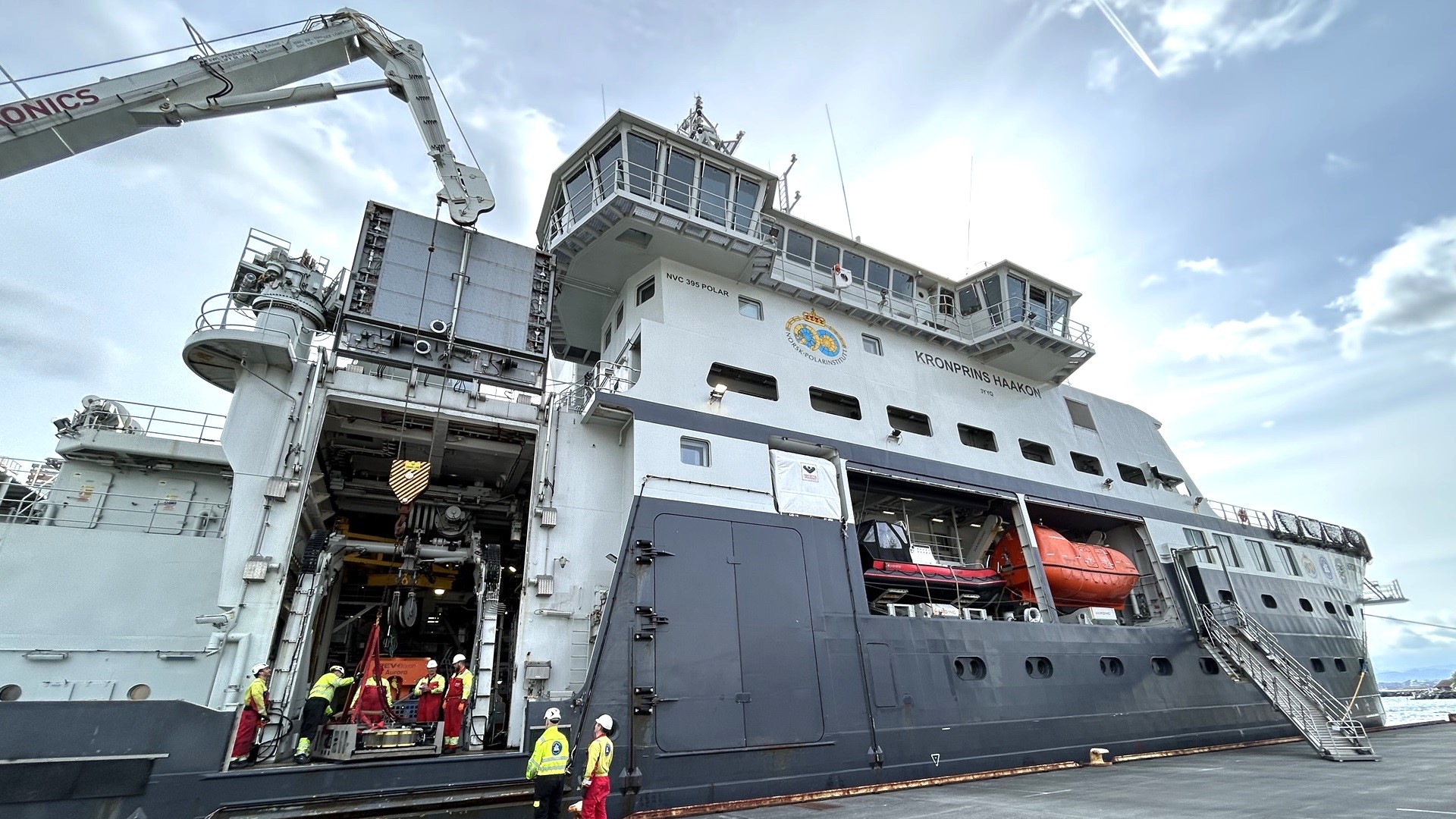
The research vessel RV Kronprins Haakon was used to map natural seeps related to the young source rock.
4/24/2025 Studies of natural oil and gas seeps from the seabed have yielded new knowledge about a previously overlooked young source rock.
Over the course of several years, the Norwegian Offshore Directorate has conducted acquisitions and studies related to natural seeps of oil and gas on the Norwegian continental shelf (NCS), both on its own initiative and in cooperation with the academic community. The objective has been to acquire better knowledge about the petroleum systems that are connected to these natural seeps, which can be quite extensive in many places.
Up to now, the greatest focus has been on the Barents Sea, but studies and acquisition efforts have also been conducted in the Norwegian Sea and in the North Sea.
“It’s the work done in cooperation with the academic community west of Svalbard that led to the discovery of the new, young source rock, and what appears to be a functioning petroleum system linked to it,” says Rune Mattingsdal. He is a geologist with the Norwegian Offshore Directorate and has worked to map natural oil and gas seeps over the course of several years.
“A functioning source rock is the most important criteria for discovering oil and/or gas”.

Rune Mattingsdal is a geologist with the Norwegian Offshore Directorate.
Scientific publication
It was in fact the natural seepage of oil from the seabed that put geologists on the trail of the “new” source rock, despite the fact that the source rock was drilled and sampled as early as in the 1990s during an international scientific drilling campaign west of Svalbard.
The natural oil seep was the topic of a scientific publication in 2024, An Arctic natural oil seep investigated from space to the seafloor.
Mattingsdal, who co-authored the scientific article, wrote a feature article in the newspaper Svalbardposten in 2024: Opinion piece in Svalbardposten: The seabed is leaking oil, and it’s 100 % natural (in Norwegian only).
In March of this year, he gave a “keynote” presentation at the Norwegian Petroleum Society conference “Exploration Revived 2025”, with the title “Hydrocarbon seeps and a new young source rock” (pdf). There he presented much of the data collected and the studies conducted in recent years related to the young source rock.
“One of the main messages was that this young source rock is probably present and has formed hydrocarbons where it’s situated, buried deep under Bjørnøyvifta (the Bjørnøya Fan)”, Mattingsdal says.
Bjørnøyvifta is located in the Norwegian Sea, west of the Barents Sea from the shelf edge and out into the deep sea. A simple basin modelling was performed in this area for the Norwegian Offshore Directorate last year.
“This modelling confirms the possibility that a young source rock has formed hydrocarbons”. Click to read the report (pdf).
Bjørnøyvifta is poorly explored, and data coverage is scarce. The area has not been opened for petroleum activity, but oil and gas that have formed may be significant for opened acreage in the westernmost part of the Barents Sea.
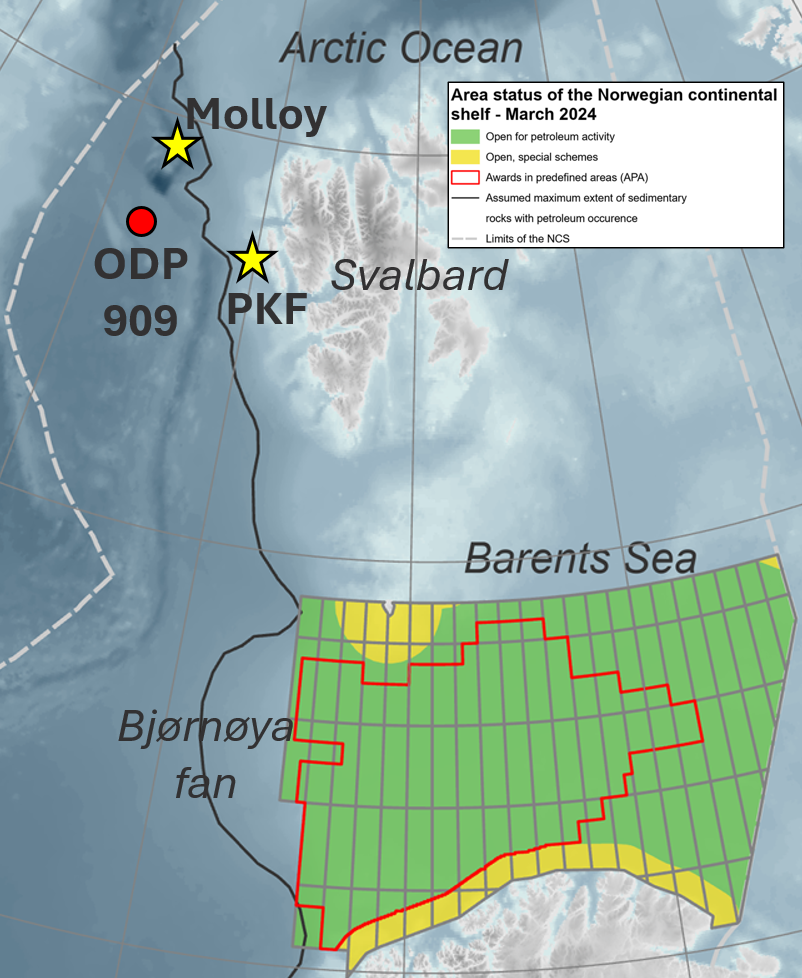
Map indicating where samples have been taken of natural oil seeps and where the young source rock was drilled. Molloy = natural oil seepage north of the Molloy Deep about 3600 metres below sea level. PKF = natural oil seepage off the Prins Karls Forland about 100 metres below sea level. ODP 909 = Ocean Drilling Program Site 909, which was drilled in 1993. Background map from norskpetroleum.no/en.
The source rock can also be found in other places
There are indications that this young source rock may be present in large parts of the Norwegian Sea, all the way down to the northernmost part of the North Sea.
“While in most places the source rock may be too shallow, it might be buried deep enough to have formed hydrocarbons in several locations in existing APA acreage (APA, Awards in predefined areas) in the Norwegian Sea, in areas where this possibility has not yet been investigated”.
The work to find out more about the presence and the potential of this young source rock will continue in 2025. As early as in May, the Norwegian Offshore Directorate will take part in new scientific surveys on Bjørnøyvifta and in the western Barents Sea.
“The plan is to collect samples of natural oil slicks on the sea surface and map the seabed to find additional seepage locations. We’ll also conduct geological and geophysical studies of natural seepages in an attempt to determine what the source rock could be,” Mattingsdal says.
Director Communication, security and emergency response
Updated: 4/24/2025