Sokkeldirektoratet

Young source rock proven common in the Norwegian Sea

Rune_og_gassprøvetaker_2

Geologist Rune Mattingsdal is co-author of the publication.

1/6/2026 For the first time, a new scientific publication has documented a young source rock with widespread presence in the Norwegian Sea.

The presence of a source rocks is the number one prerequisite for forming petroleum. Documentation of a new source rock can create new exploration opportunities, particularly in areas with no previously known source rocks.

The Norwegian Offshore Directorate has been involved in studies of natural oil seeps on the NCS over several years. These studies have yielded new knowledge about a young source rock that, so far, has been overlooked.  

Published on ScienceDirect
In a new article on the online research platform ScienceDirect, much of the work is compiled and documented scientifically.
 
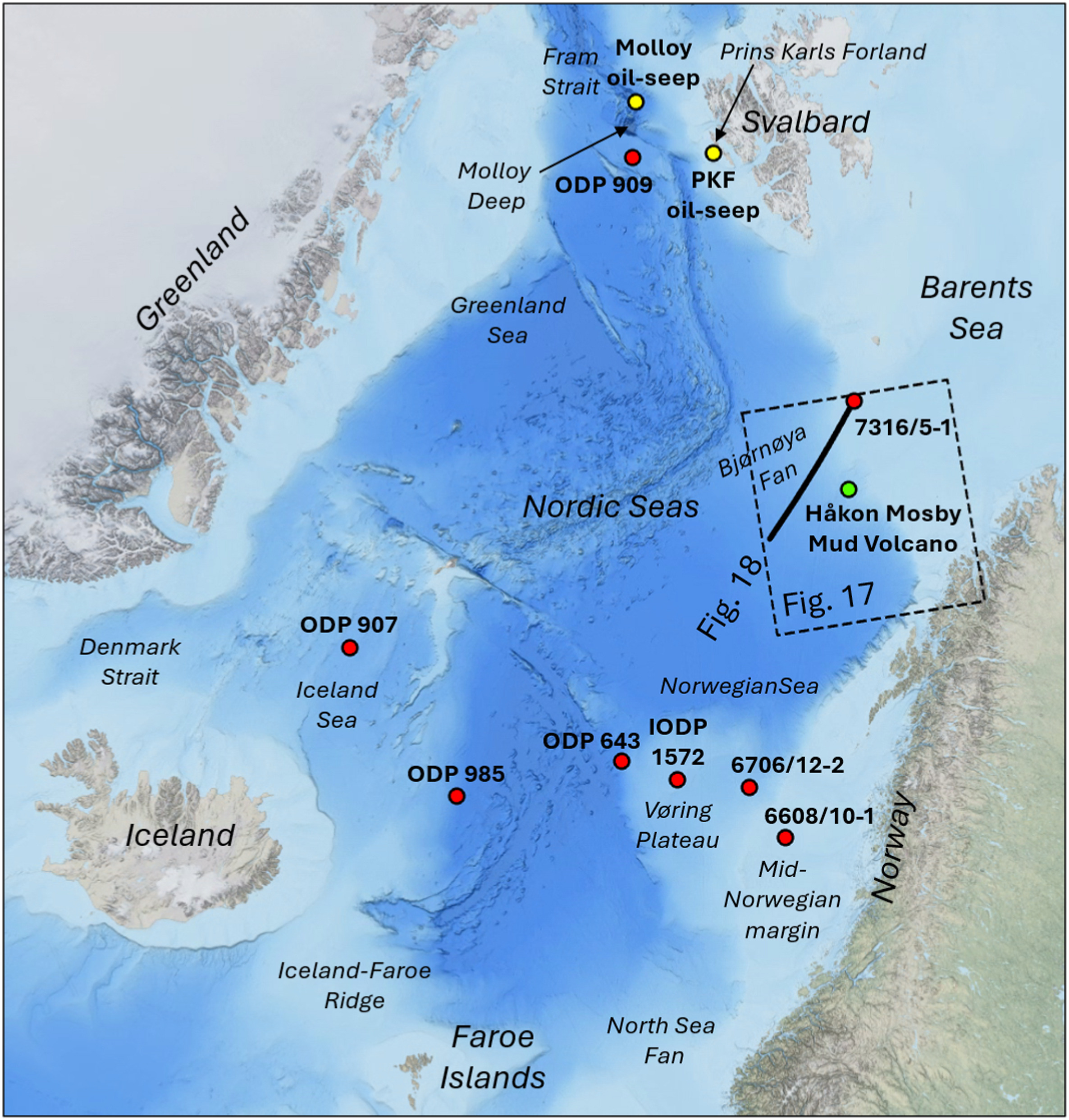
This publication links natural oil seeps west of Svalbard with proven Early to Middle Miocene (in this context, about 17 million years ago) intervals in several scientific boreholes and exploration wells in large parts of the Norwegian Sea (see map below).

The map shows the two natural oil seeps west of Svalbard, and scientific boreholes and exploration wells where a young Miocene source rock has been proven.
The map shows the two natural oil seeps west of Svalbard (yellow dots), and scientific boreholes and exploration wells where a young Miocene source rock has been proven (red dots).  

Too shallow?

Basin modelling shows that this source rock can be oil-mature below the Bjørnøya Fan west of the Barents Sea.

"One of the most exciting results is that the studies document a young source rock from what used to be a large-scale deltaic sedimentary environment in large parts of the Norwegian Sea. The sedimentary conditions can best be compared with the conditions in the Niger and Congo deltas off the coast of West Africa".

Those were the words of geologist Rune Mattingsdal at the Norwegian Offshore Directorate, who is a co-author of the publication.

Despite the fact that, in most places, the source rock will most likely be buried too shallow to form oil, it may, as is the case below the Bjørnøya Fan, potentially be buried deep enough to form hydrocarbons in several locations in existing APA acreage (APA, awards in pre-defined areas) in the Norwegian Sea, in areas that have not yet been explored with regard to this opportunity.


Contact
postboks@sodir.no

Tel: +47 51 87 60 00

Updated: 1/6/2026

Latest news

Drilling permit for wellbore 6507/8-D-4 CH
1/23/2026 The Norwegian Offshore Directorate has granted Equinor Energy AS drilling permit for wellbore 6507/8-D-4 CH in production licence 124.
Production figures December 2025
1/20/2026 Preliminary production figures for December 2025 show an average daily production of 2 190 000 barrels of oil, NGL and condensate.
Gas and condensate discovery in the North Sea (15/8-3 S)
1/20/2026 Equinor and its partner ORLEN have discovered gas and condensate in the "Sissel" prospect in production licence 1137.
Oil discovery in the Norwegian Sea (6507/8-12 S)
1/19/2026 Equinor and its partners have proven oil in wildcat well 6507/8-12 S in production licence 124 B.
Drilling permit for wellbore 34/8-A-37 H
1/16/2026 The Norwegian Offshore Directorate has granted Equinor Energy AS drilling permit for wellbore 34/8-A-37 H in production licence 120.
Appraisal well confirms oil discovery in the Barents Sea (7122/8-3 A)
1/16/2026 Vår Energi's appraisal well 7122/8-3 A has confirmed the 7122/8-3 S ("Zagato") oil discovery in the Goliat area.
19 companies offered ownership interests
1/13/2026 In the 2025 awards in pre-defined areas (APA), 19 companies have been offered ownership interests in a total of 57 production licences on the Norwegian continental shelf (NCS).
Best exploration year in several years
1/8/2026 Last year's exploration result was among the best in several years, according to the Norwegian Offshore Directorate's summary of activity on the Norwegian continental shelf (NCS) in 2025.
Young source rock proven common in the Norwegian Sea
1/6/2026 For the first time, a new scientific publication has documented a young source rock with widespread presence in the Norwegian Sea.
The Shelf in 2025 will be presented on 8 January
1/2/2026 On 8 January 2026 at 10:00 o'clock, you can hear the figures, trends and stories.