
Vast gas resources may lie here
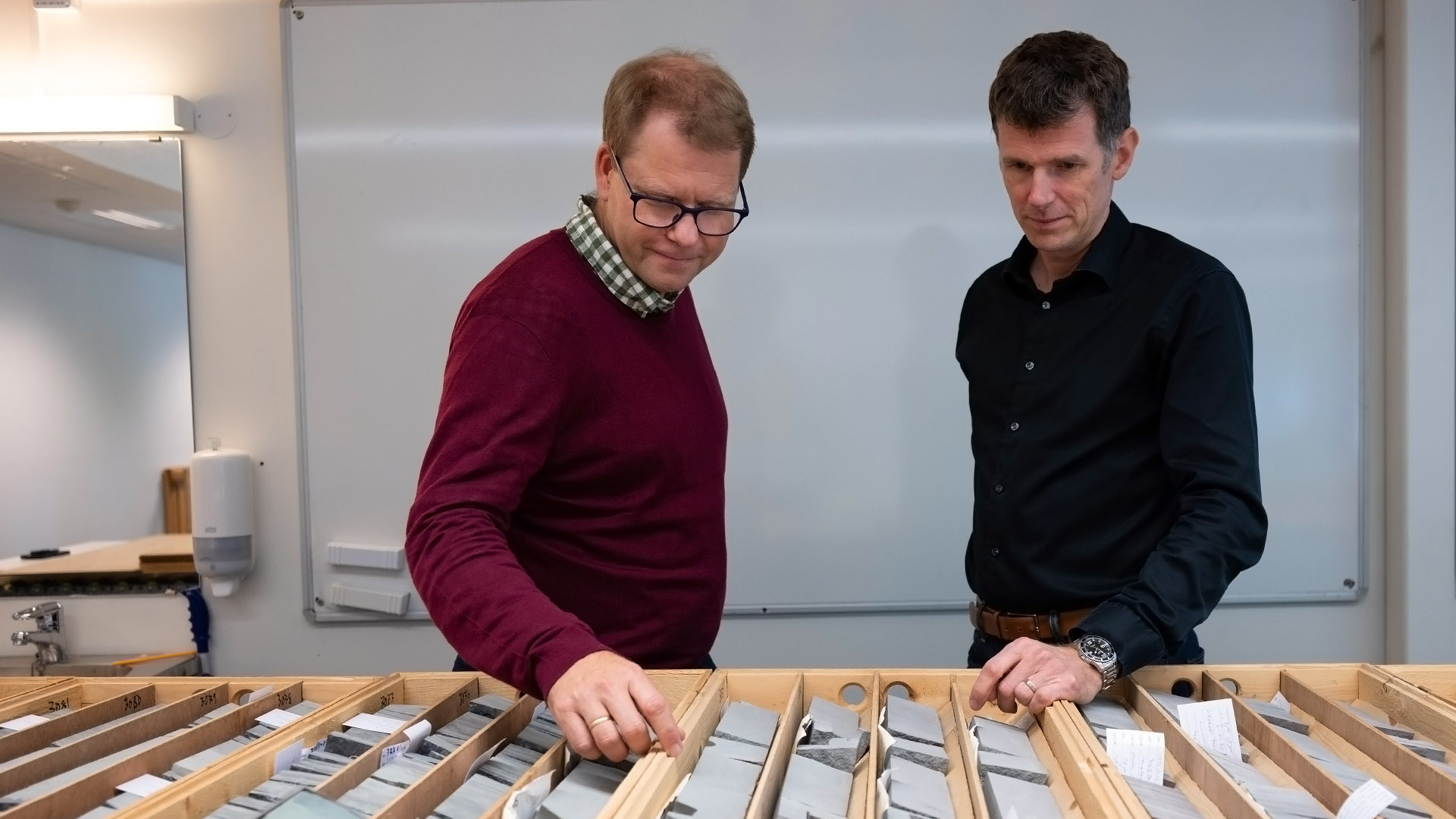
Arne Jacobsen, Assistant Director for Technology and Subsurface, and Dries Uyttendaele, senior geologist, with core samples from the Norselhøgda discovery in the Barents Sea. The Norwegian Offshore Directorate has initiated a study that could provide more information about the size of this discovery. (Photo: Johanne Bjørklund/Norwegian Offshore Directorate)
10/21/2026 The Barents Sea is home to a number of discoveries that could hold vast volumes of gas. A new study could uncover major opportunities for one of these discoveries.
The Barents Sea remains less-explored than other parts of the Norwegian continental shelf (NCS), but several discoveries in these waters may contain significant volumes of gas.
“Several major gas discoveries have been made in the Barents Sea which we still don’t know much about. Norselhøgda is one of a number of discoveries the Norwegian Offshore Directorate believes the companies should take a closer look at,” says Arne Jacobsen, Assistant Director for Technology and Subsurface.
Norselhøgda is situated about 200 km north of Hammerfest. A gas discovery was made here in well 7226/11-1 in 1988. The discovery was production-tested, but the acreage was subsequently relinquished to the authorities.
A new study could tell us more about the size of the discovery
The Directorate has therefore hired the consulting company Terra Stream Energy to carry out a study that could bring new knowledge about the more precise volume of recoverable resources in the discovery.
“The objective is to develop a model that can be shared with the companies so they can make further assessments of mapping and technologies that could help realise a potential development,” Jacobsen says.
The reservoir is tight and will probably require stimulation. This is technology that is already being used on the NCS and elsewhere in the world.
More discoveries in the area
Several comparable discoveries have been made in the area. These include production licence 1313, located to the north of the Norselhøgda discovery and awarded in APA 2025 (awards in predefined areas).
“It’s possible that these discoveries could be viewed in an overall context. There could be benefits to extract if 1313 is developed further. The companies will have an opportunity to apply for Norselhøgda in the next APA round,” says Jacobsen.
Development of this potential rests on development of infrastructure, and is particularly relevant for increased gas export opportunities.
“Realising Norselhøgda could be one step towards bringing this all into place,” Jacobsen says.
He notes that the gas proven in the area has a very low CO₂ content, just 0.3 per cent. Development and production of gas with low CO2 content provides added flexibility in exploiting existing infrastructure.
The study is scheduled to be completed towards the end of this year. In connection with this, the Norwegian Offshore Directorate plans to share the model and hold a professional seminar for the industry.
More information:
The Gro discovery in the Norwegian Sea is another discovery the Norwegian Offshore Directorate hopes to revive, along with the Linerle discovery in the Norwegian Sea.
Tight reservoirs: Profitable production of tight reservoirs.
Read more about the Norwegian Offshore Directorate’s work to develop idle gas resources: Valuable gas resources untouched.
Want to learn more about future prospects on the NCS? You can find out more in Resource Report 2026, which also contains more information about increased gas export capacity from the Barents Sea.
Updated: 10/21/2026