60 years since the hunt for oil and gas began
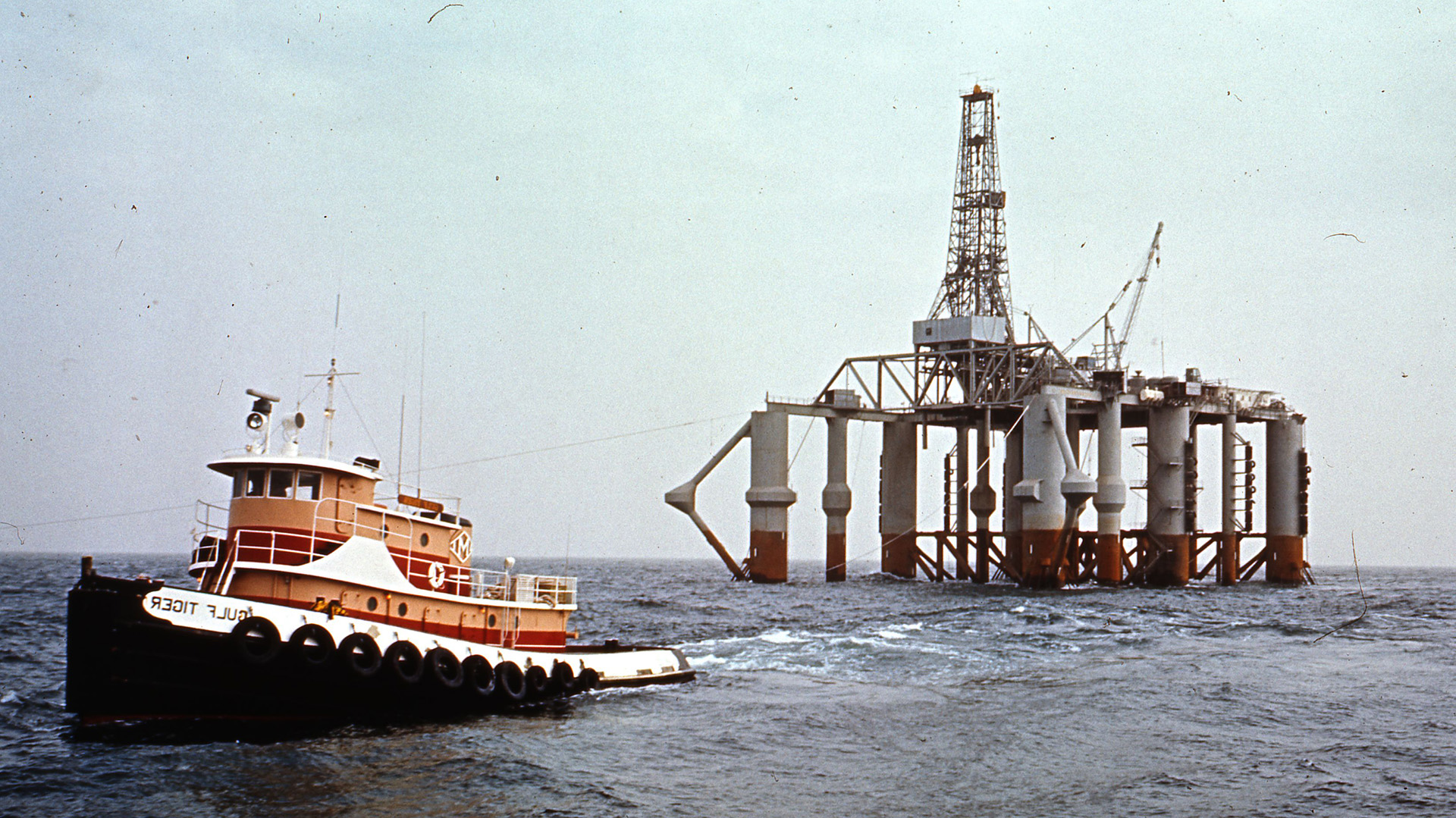
In 1966, the rig Ocean Traveler was transported across the Atlantic to begin exploration for oil and gas in Norwegian. Photo: Odeco. CC BY 4.0. Source: Digitalarkivet (https://goto.digitalarkivet.no/c8cb6ec4-8a51-4baf-9e87-7121787e31c8)
6/17/2026 On Tuesday 19 July 1966 at 08.20, drilling commenced on the first exploration well on the Norwegian continental shelf (NCS).
This summer marks 60 years since the oil and gas hunt got underway. This is the first of four articles about exploration on the Norwegian continental shelf.
The summer of 1966 was the start of a significant chapter in Norwegian history. The first exploration well was drilled, and although the well was dry, the operation provided important information regarding North Sea geology.
The hope of finding oil and gas was revived, even though eight years earlier, the Geological Survey of Norway (NGU) had concluded that petroleum resources on the NCS were unlikely. So, what happened in the meantime?
An unusual summer in Stavanger
The summer of this year was the kind that makes the headlines for the right reasons. But it wasn´t just the good weather that had people talking. The manned space mission to Nasa was of course front-page news in Stavanger Aftenblad. Simultaneously, an unfamiliar construction appeared in Stavanger one memorable night in June.
On 22 June, the drilling rig Ocean Traveler anchored in Dusavik, a short drive north of the city centre. The oil company Esso had leased the rig from the American company Odeco. The fact that a drilling rig had come to Stavanger in search of oil and gas caused quite a stir. Many curious locals felt compelled to go and see it for themselves.
How did the rig end up here, ready to explore on the NCS? NGU had already established in 1958 that “any possibility of discovering coal, oil or sulphur on the Norwegian continental shelf along the Norwegian coast can be ruled out.”
The first well
- This summer marks 60 years since the Ocean Traveler rig drilled the first wildcat well on the Norwegian continental shelf.
- Although the well was dry, it was in many ways the first decisive step into the petroleum era.
- Approximately one fifth of the economic value added to the Norwegian economy comes directly from oil and gas activities.
- More than 200 000 people are directly or indirectly employed in the petroleum industry. This corresponds to approximately 10 per cent of private sector employment in Norway.
- To slow down the decline in production, it is important that the companies continue to explore, both close to existing infrastructure and in underexplored areas.
The gas discovery in the Netherlands gave new hope
The explanation was found in the Netherlands in 1959, when the Dutch made one of the largest natural gas discoveries in the world beneath grain and potato fields around Groningen. The discovery sparked interest among the major oil companies and caused geologists to look to the North Sea with renewed hope. After all, the geology in Groningen wasn´t so different from that of the North Sea, was it?
Expectations alone are not enough. In October 1962, Phillips Petroleum applied for a permit to explore in Norway. The company wanted a licence for the Norwegian North Sea territory and bid 160,000 dollars per month. The Norwegian government interpreted this as an attempt to secure exclusive rights – and declined. The consensus was that more companies needed to be included if the area was to be opened for exploration. Much regulatory work also remained.
Sovereignty, division and licensing round
In May 1963, the Gerhardsen government declared Norwegian sovereignty over the Norwegian continental shelf. A new law established that the state was the landowner, and only the government could grant permission for exploration and recovery. The companies were invited to conduct surveys, or seismic mappings.
However, the division of the continental shelf, mainly with Denmark and Great Britain, had not yet been clarified. Almost two years after the 1963 declaration of sovereignty, the agreements on division according to the midline principle were finally in place. First came the agreement with Great Britain in March 1965, followed by the agreement with Denmark in December of the same year.
In April 1965, the government announced the very first licensing round. A total of 278 blocks, each measuring 500 km2, south of the 62nd parallel, were available. 11 applications were received, and in August the first licence awards on the Norwegian shelf were a fact: 22 production licences across 78 blocks.
No drilling without a rig
With the licences in place, the practicalities had to be sorted. Esso was swift to sign a contract with the American rig company Odeco. There were no drilling rigs in Norway, so Ocean Traveler was transported from the Gulf of Mexico. The operation was both enlightening and demanding. One of the floating pontoons began to leak and had to be repaired when the rig arrived in Stavanger.
It also quickly became clear that a construction designed for the Gulf of Mexico would not be equally suited to the harsh North Sea environment. Ocean Traveler was built for smaller waves and less wind. The platforms on the NCS therefore had to be built more robustly to withstand Norwegian conditions.
The rig was repaired in Stavanger, and following inspections by several Norwegian supervisory authorities, the go-ahead was given in June 1966. Drilling for oil could officially start in the North Sea, and Ocean Traveler was transported to block 8/3, 160 kilometres southwest of Stavanger.
Dry well, but valuable knowledge
On 19 July at 08.20, drilling commenced. Ocean Traveler launched its historic drilling operation at a water depth of 94 metres. Drilling at such impressive depths was a technological feat. Drilling was completed in October 1966 after around 80 days, at a depth of 3015 metres, but the results were disappointing. Well 8/3-1 was dry.
Nevertheless, the work was not wasted for Esso. The drilling confirmed that the geology far out in the North Sea was indeed similar to that of the Netherlands. This gave new hope. The operation also proved that it was possible to drill for oil and gas in this harsh climate area.
Collision and traces of oil
In November, Odeco was asked to move Ocean Traveler, and the rig headed northwest to block 25/11. The operation wasn´t plain sailing this time round either. The rig collided with the supply ship Smit-Lloyd during offloading. The hole in one of the pontoons allowed water to flow in, and the rig listed heavily. Several of the crew threw themselves into the sea. By releasing water into the pontoons on the opposite side, the rig was fortunately stabilized. Odeco halted the drilling operation, and Ocean Traveler had to travel back to Stavanger for repairs.
It was not until March 1967 that the rig was back on the field, and the drilling of well 25/11-1 could continue. The operation was completed in July and this time round, traces of oil were found, or more specifically, traces of hydrocarbon in the lower tertiary. The first drops could be taken on board and tested in the laboratory.
The scenes were not ones of unadulterated jubilation. Esso believed the discovery was too small to be commercially developed. Subsequent events proved otherwise. This was the Balder field, which came on stream 30 years later and contained around 110 million cubic metres of oil (700 million barrels).
Ocean Traveler had completed its mission. In 1967, it found traces of oil, which later proved to be Balder. This story also points to an important feature in Norwegian oil and gas history: The combination of technological development and patience is unbeatable – and can over time push the boundaries of what is possible to achieve.

"Rolf Øverland is one of the pioneers on the Norwegian continental shelf." (Photo: Bodil Øverland)
Sources and further reading
- The Norwegian Petroleum Museum – timeline and introduction to Norwegian oil history
- Geo365: The first oil (Norwegian only)
- E24: "Rocky" is one of Norway's pioneering oil workers: "There were a lot of Texas conditions" (Norwegian only)
- E24: 50 years since the start of Norwegian oil drilling (Norwegian only)
- Trude Meland and Helge Ryggvik (2024): “Norwegian oil rig history. Through smooth and stormy waters.” Stavanger, Wigestrand Forlag.
- Egil Helle (1984): “Norway's oil – the first 20 years”. Oslo, Tiden Norsk Forlag.
Read more about the history of exploration
Updated: 7/9/2026